A Story of Six Minutes That Changed Three Lives
The Honda had been sitting in the garage since March of 2006.
Same parking spot. Same canvas cover. Same Starbucks cup in the cup holder — the contents long since evaporated to a thin brown crust on the bottom. The receipt on the passenger seat had faded almost to white, but you could still make out the words: “thank you, come again.”
She had not opened that garage door more than four times in nineteen years. Once to get the Christmas lights. Once when the neighbor’s cat got in. Twice to argue with insurance adjusters about whether the car was worth more as scrap or as a memory.
She had always chosen memory.
This past November, she finally chose scrap.
The tow truck was scheduled for Friday at 11 a.m. She had two days to clear anything personal out of the car.
She kept telling herself she was just going to grab the registration papers and his sunglasses and the little Saint Christopher medal he kept clipped to the visor. That was it. Twenty minutes. She would not look at the driver’s seat. She would not put her hand on the steering wheel. She would not sit in there.
She lasted four minutes.
The Car
The canvas cover came off in one long pull, and the dust she released into the afternoon light was so thick she had to step back and breathe through her sleeve.
The car was the color of a coin you find in a couch cushion. Silver, once. Greyer now. The driver’s side mirror had a spider’s web stretched between it and the door frame, woven by a spider that had clearly given up years ago and never come back.
She walked around to the driver’s side. She did not let herself look through the window. She put her hand on the door handle and pulled.
The handle gave its old familiar click — that small metallic sound she had not heard in nineteen years, and which her body recognized before her mind did. She made a small involuntary noise. Not a word. Just air.
The door swung open. Stale, cold, slightly sweet air rolled out.
She slid into the driver’s seat.
The leather creaked under her weight the way it used to creak under his.
The Glove Box
She knew she would cry if she sat there too long, so she made herself useful. She reached across and popped the glove box.
His registration papers were on top, in the manila folder he had always used, his neat engineer’s handwriting in the corner: “car — keep current.”
Under the papers were his reading glasses. One lens had a hairline crack across it that had not been there in 2006. The plastic case had been knocked around inside the glove box every time she had opened it over the years — maybe four times, maybe five — but she could not remember dropping them.
Under the glasses, all the way at the back, was something she had completely forgotten existed.
A small black flip phone. A Motorola RAZR V3. The phone he had been holding when he kissed her goodbye that morning.
The battery cover was slightly loose. There was dust in the seam. She held it in her palm and felt its weight, which was almost nothing, and yet which was the heaviest object she had ever held in her life.
She had not seen this phone since the police gave it back to her in a clear plastic bag, three weeks after the accident. She had put it in the glove box because she could not bear to bring it into the house, and she had told herself she would deal with it later.
Later had taken nineteen years.
She pressed the power button. She did not expect anything. The battery had been dead since George W. Bush was halfway through his second term.
The screen flickered.
It glowed faintly blue-green.
The Motorola startup chime played, that tiny chirping melody she had not heard since the iPhone replaced everything, and she put her hand over her mouth because it sounded exactly like him.
The phone booted to the home screen. One bar of battery. The clock was wrong — frozen on the day it had last been on.
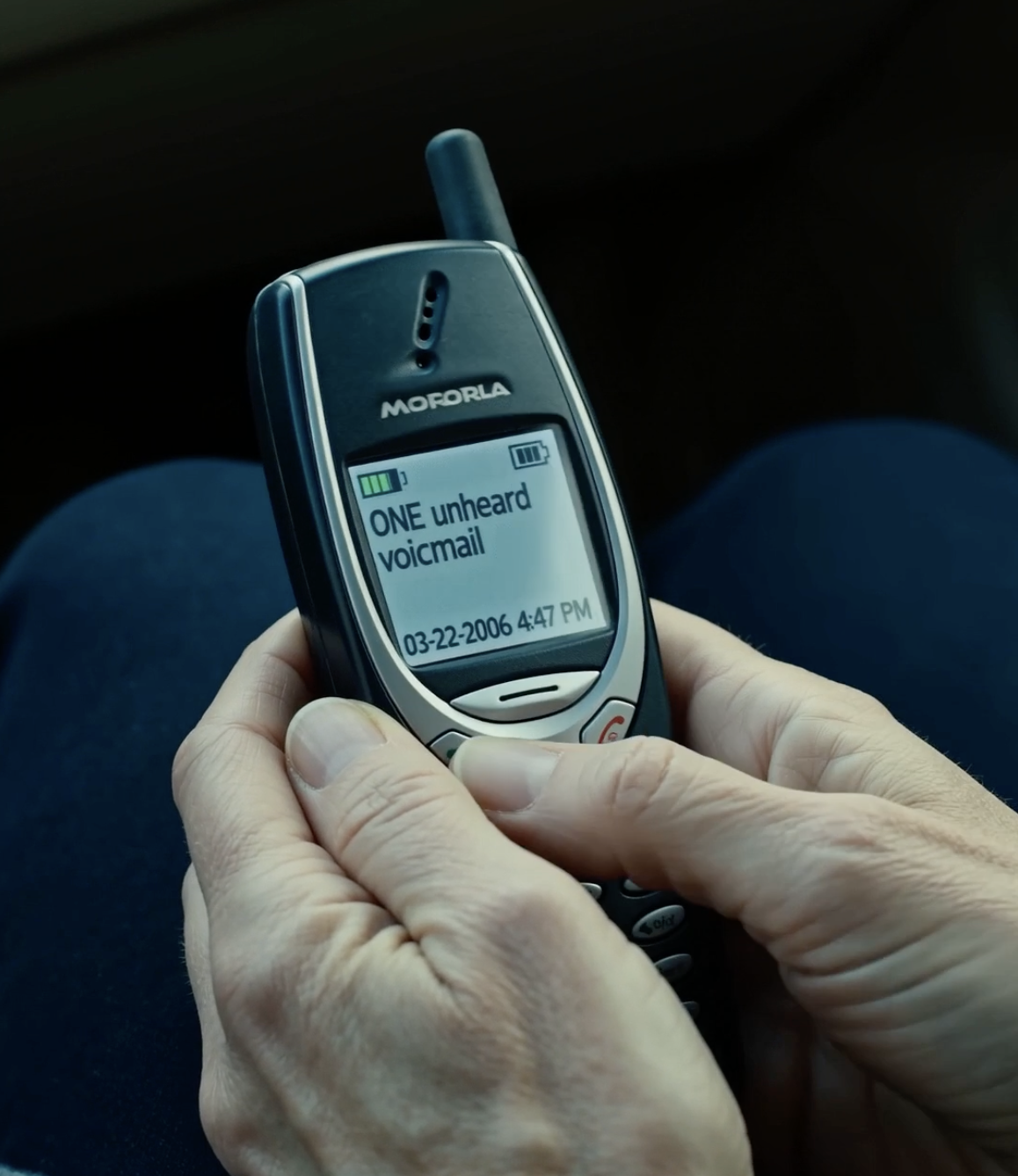
And there, at the top of the screen, was a small icon she had never seen on this phone before.
One unheard voicemail.
Timestamped 4:47 PM, March 22, 2006.
Six minutes before the accident.
What She Knew About That Day
He had left the house at 7:15 that morning. He had a sales meeting in Tacoma. He had kissed her goodbye in the driveway. She was four months pregnant with their first child and had been throwing up since 5 a.m., and he had brought her a piece of dry toast and a ginger ale before he left, and he had laughed and said “I’ll call you when I’m done, don’t move.”
He had called her at 11 a.m. The meeting had gone well. He was driving home. He would be back around five.
He had not made it home.
A semi-truck had crossed the median on Interstate 5 at 4:53 PM and hit his car head-on. He had been killed instantly. The truck driver had been awake for thirty-one hours. There had been a settlement. There had been a funeral. There had been a baby, born five months later, who looked exactly like him.
None of it had ever made sense to her. He had been the most cautious man she had ever met. He had not been speeding. He had not been on his phone. He had not been doing anything wrong.
He had simply been in the wrong lane at the wrong second.
And now, nineteen years later, she was sitting in his car, holding his last phone, looking at a voicemail he had never gotten the chance to hear.
She did not recognize the phone number on the screen. It was a Washington state area code, but it was not anyone she knew. Not his mother. Not his sister. Not anyone from work.
Her thumb hovered over the call button for what felt like a long time.
Then she pressed play.
She lifted the phone to her ear.
The Voicemail
The voice on the other end was a woman.
She was crying.
She was crying the way a person cries when they have been holding it together for the last twelve hours and have finally lost the ability to do that. Her words were broken in the middle.
She said:
“David, please — don’t come.”
“There’s been a — I need to tell you before you get on the road. Please pick up. Please. He’s gone. He passed about an hour ago. I’m so sorry, I’m so sorry, I tried to reach you all morning and your phone went to voicemail and I — I didn’t want you to find out from your dad. He’s gone, David. Dad is gone. Please call me back before you start driving home. Please don’t drive if you’re upset. I know you. Please call me. I love you. I’m so sorry.”
The voicemail ended.
She sat in the driver’s seat of his car with the phone still pressed to her ear, listening to the silence after the message, and she understood — slowly, the way you understand something that has been waiting nineteen years to be understood — three things at once:
The woman on the voicemail was her husband’s older sister, Maureen. Maureen, whom he had not spoken to in two years because of a fight over their father’s care. Maureen, who had refused to come to the funeral, and who had cut off the family entirely after, and who she had blamed quietly, in her heart, for everything.
Her husband’s father had died at 3:50 PM on March 22, 2006.
And her husband had never known.
What She Had Believed for Nineteen Years
For nineteen years, she had believed that her husband had died on his way home from a successful sales meeting, completely unaware that his father had passed just an hour earlier.
She had drawn comfort from that. She had told herself: at least he didn’t have to grieve. At least his last hour was a normal hour. At least he was driving home to me, thinking about the baby.
She had hated Maureen for nineteen years for not calling, for not telling them, for letting their father die alone in a hospital room.
But Maureen had called.
Maureen had called him.
She just hadn’t been able to reach him — because his Bluetooth had been broken since February, and she didn’t have his work number, and she had left a voicemail at 4:47 PM, six minutes before the accident, and her brother had died without ever knowing she had tried.
And Maureen — Maureen had spent the last nineteen years believing that her brother had died angry at her. That his last hours on Earth had been spent thinking she was a daughter who had abandoned their father. That he had gone to his grave without forgiveness.
When in reality, he had simply never gotten the message.
What She Did Next
She sat in the car for a long time. The light through the garage window moved across the dashboard. The phone in her hand went down to no bars of battery, and the screen finally died, and the voicemail with it.
It was the last time anyone would ever hear that recording.
She went back into the house. She made a cup of tea. She let it go cold on the counter.
Then she did the thing she had refused to do for nineteen years.
She picked up her phone, and she called her sister-in-law.
Maureen answered on the third ring. Her voice was the voice of a sixty-eight-year-old woman now, not the young voice on the voicemail, but the cadence was exactly the same.
She said: “Maureen, it’s me.”
There was a long silence on the other end.
Then Maureen said: “I know.”
And then both of them, on opposite ends of the state of Washington, on a cold afternoon in November, cried together for the first time in nineteen years.
What I Asked Her
I asked her, when I sat with her last month, what she would do differently if she could go back.
She thought about it for a long time. She was holding a cup of coffee that had gone cold the same way the tea had gone cold that afternoon in November.
She said:
“I would have charged the phone. The day they gave it back to me. I would have charged the phone, and I would have called every single number in it, and I would have asked every person on the other end: tell me what you wanted to say to him. Tell me what he didn’t get to hear. Because I spent nineteen years thinking I knew what his last day looked like. And I was wrong.”
She paused.
“There’s almost always a message. We just don’t think to look.”
“You don’t lose people all at once.
You lose them one unread message at a time.”
If this story moved you, share it with someone who needs to hear it.
Somewhere in your phone, or your inbox, or the back of a glove box you haven’t opened in years, there is probably a message waiting.
Find it before another nineteen years go by.