How a quiet kitchen drawer in a small Ohio house held something Sarah Whitfield was never supposed to find — and what the recipe turned out to be
In the spring of 2025, a forty-two-year-old elementary school teacher named Sarah Whitfield finally moved back into the house where she had grown up.
The house was on Linden Avenue in a small town outside Akron, Ohio. It had four bedrooms, a screened porch on the back, a garden that had grown wild in the five years since anyone had tended it, and a kitchen that had not been touched since the morning of March 17, 2020 — the morning Sarah’s mother, Eleanor Whitfield, had been taken to the hospital with what she had described to her daughter on the phone, in her usual cheerful tone, as “a little chest cold that I’m sure is nothing, sweetheart.”
It had not been nothing.
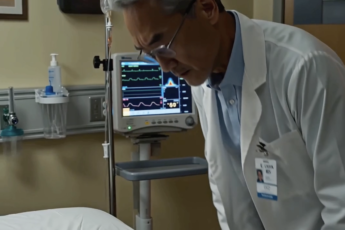
Eleanor had died of complications from COVID-19 on the morning of March 22, 2020, in a hospital room in Akron, with nobody allowed to be present except for the chaplain who held a phone to her ear while Sarah, in her apartment in Cleveland, said the only goodbye she was permitted.
After her mother’s death, Sarah had not been able to face the house. She had paid a property management company to keep the lawn cut and the pipes from freezing. She had not been inside for almost five years.
In April of 2025, her own marriage ended. She did not contest the divorce. She packed two suitcases and a cardboard box of books, drove three hours south on I-77, and let herself into the house on Linden Avenue at 11:14 in the morning on a Tuesday.
The first thing she noticed was the smell.
It was her mother’s smell. Lavender from the soap dish in the upstairs bathroom. Cedar from the linen closet. The faint sweetness of the cinnamon her mother had kept in a small tin on the kitchen windowsill for as long as Sarah could remember.
Sarah stood in the front hall for a long time. She did not cry. She had cried so much over the last five years that her body had, she sometimes thought, simply run out of the ability to do it in any way that felt connected to her actual grief.
She put her suitcases down.
She walked into the kitchen.
The Drawer
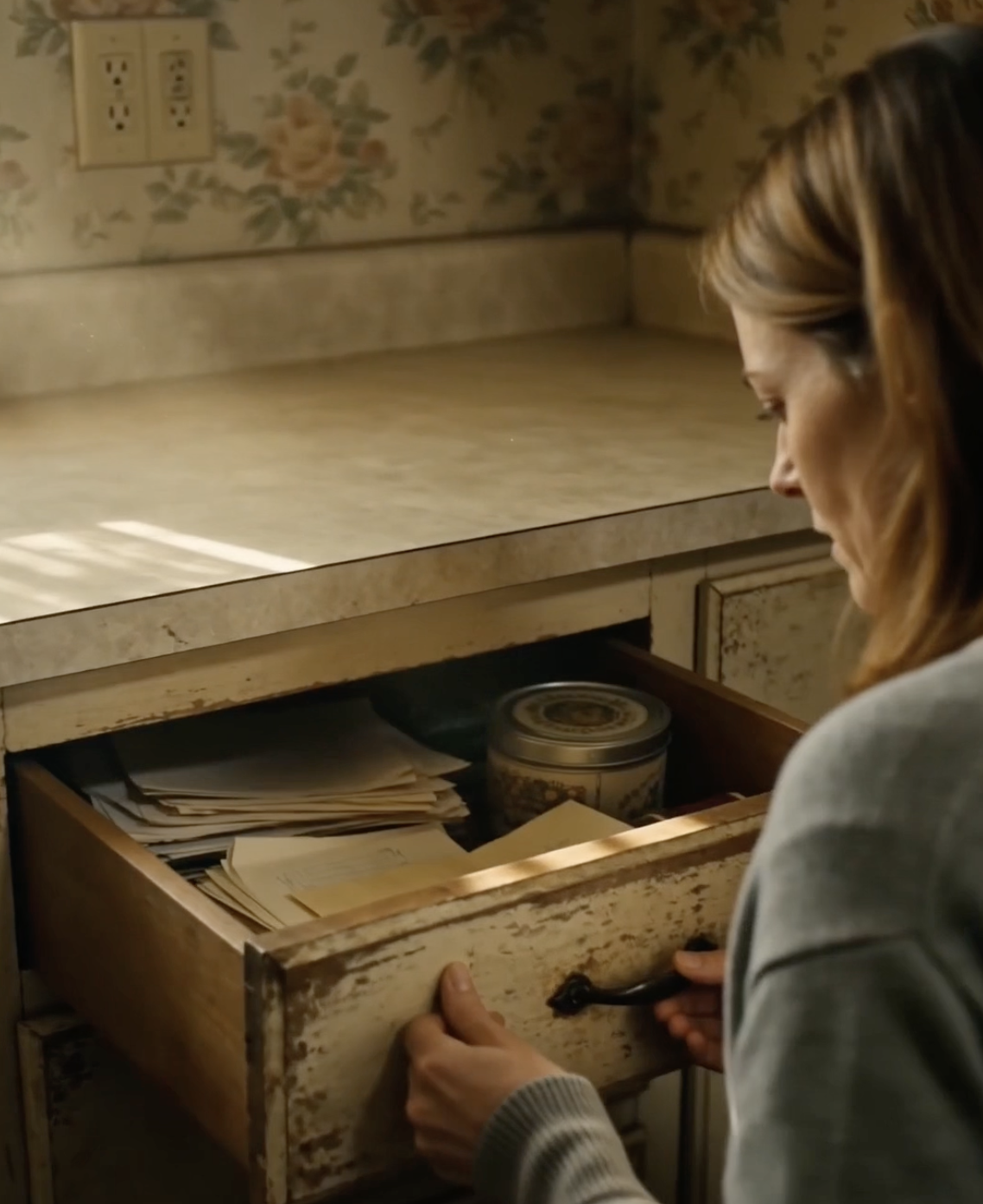
The kitchen at Linden Avenue had eight drawers. Sarah had grown up opening seven of them.
The eighth drawer was on the lower left, beneath the silverware drawer, beside the dishwasher. It had always been stuck. As a child, Sarah had asked her mother what was in it. Her mother had said, with the kind of casual dismissiveness that, in retrospect, Sarah would recognize as deliberate: “Oh, nothing, sweetheart. Just old things. It’s stuck anyway. Don’t worry about it.”
Sarah had not worried about it. For thirty years, she had not worried about it.
On the afternoon of April 14, 2025 — her third day back in the house — Sarah was cleaning out the kitchen. She had filled four black trash bags with expired pantry items, two boxes with dishes she planned to donate, and one box with things she wanted to keep. She was tired. She was hungry. She had not eaten anything since a granola bar at the gas station that morning.
She tried the eighth drawer.
It was, as it had always been, stuck.
She got a butter knife. She wedged it into the gap above the drawer. She lifted, gently, the way her father had taught her when she was eight years old and had wanted to fix a sticky window in her bedroom.
The drawer came open with a small, sighing sound.
Inside the drawer were:
- Three small notebooks bound with rubber bands
- A vintage tin that had once held Whitman’s chocolates and now held buttons
- An envelope marked, in her mother’s handwriting, “For Sarah — when she is ready”
- A folded square of red gingham fabric
- And a single recipe card
The recipe card was on top of everything else.
Sarah picked it up first.
The Card
The recipe card was the kind that Eleanor had kept in a metal box on the kitchen counter all of Sarah’s childhood. White cardstock, faintly yellowed, with a small printed border of cornflowers around the edge. Eleanor had written hundreds of them over the years. Sarah had inherited the metal box of recipes after the funeral. She had read them. She had cooked from them. She knew her mother’s handwriting on a recipe card the way she knew her mother’s voice on the phone.
The card in the drawer was in Eleanor’s handwriting.
The card was titled, in blue ballpoint pen, Grandma Wexler’s Pierogi.
The date written under the title, in the same blue ink, in the same handwriting, was August 11, 2024.
Sarah looked at the date.
She looked at the date for a long time.
Her mother had died on March 22, 2020.
The date on the card was four years, four months, and twenty days after her mother had been buried.
Sarah sat down on the kitchen floor.
She held the card in both hands. She held it so carefully that anyone watching would have thought she believed the paper might dissolve if she breathed on it.
She read the recipe.
The recipe was for a Polish pierogi filled with potato, sauerkraut, and a particular brand of farmer’s cheese that Sarah had never heard of. The dough required two ingredients she did not recognize — a kind of buckwheat flour her mother had never used and a fermented dairy product called zsendice that Sarah had to look up on her phone later that afternoon, sitting at the kitchen table with the card still in her hand. (It turned out to be a Carpathian shepherd’s whey product, traditionally made in the highland regions of southern Poland and Slovakia.)
The recipe had specific notes in the margins. “Make the dough the night before.” “Do not over-boil — they fall apart.” “My mother always made these on the second Sunday of October. I want you to know how.”
The note in the lower right corner of the card said:
“Sarah-girl. If you found this, you found the drawer. Read the letter. — Mama.”
The Letter
The envelope was the same kind of envelope her mother had always used for birthday cards. Cream-colored, slightly textured, with a small American flag stamp in the corner. The flap was sealed.
Sarah’s name was written on the front in her mother’s handwriting.
She opened it.
The letter was three pages long. It was written on the lined yellow legal-pad paper her mother had always preferred for serious correspondence — the same paper on which Eleanor had written the letter Sarah received when she’d gotten into college, and the letter she’d received when she had announced her engagement, and the letter she had received, in her senior year of high school, when she had told her mother she had been the only girl in her chemistry class who had been brave enough to apply for the national science fair.
Eleanor had not used yellow legal-pad paper for trivial things.
The letter began:
“Sarah-girl,
If you are reading this, two things are true.
The first is that the eighth drawer in our kitchen finally opened.
The second is that you came home.
I knew you would.
I want to tell you about my mother.”
The letter that followed was a quiet, careful, three-page account of Eleanor Whitfield’s mother — Sarah’s grandmother, a woman named Anna Wexler — whom Sarah had never met. Anna had died of cancer in 1979, eight years before Sarah was born.
The letter explained that Anna had emigrated from a village in southern Poland in 1947, at the age of nineteen, with no family, no English, and no possessions other than the clothes she had been wearing when the displaced-persons office in Hamburg had put her on a ship to New York.
Anna had spent the next thirty-two years of her life in the United States. She had married. She had had one daughter, Eleanor. She had worked in a fabric factory in Cleveland for twenty-six years.
She had never, in all the time Eleanor had known her, talked about the village where she had grown up. She had never talked about her own mother. She had never made the food she had been raised on.
She had carried, the letter explained, “a kind of silence that I, as her daughter, learned to honor, because she had earned it, and because I knew the silence was the only thing she had been able to take with her.”
Eleanor had not learned, until her own mother was dying in a hospice in 1979 — when Eleanor was twenty-eight years old and pregnant with Sarah — that Anna had a sister. A younger sister, named Marta, whom Anna had last seen on the morning of October 17, 1944, in a village called Niedzica, in what was then occupied Poland.
Anna had been sixteen years old. Marta had been thirteen.
What had happened to Marta after that morning, Anna had never known. She had never tried to find out. She had told Eleanor, in the hospice, that she had stopped trying after the war ended, because “some things you stop asking, because the asking is harder than the not-knowing.”
Anna had died three days after she told Eleanor this.
Eleanor had been twenty-eight years old. She had not had time to ask any of the questions she had wanted to ask.
The letter continued:
“For forty-five years, Sarah-girl, I did not look for my mother’s sister.
I told myself it was respect. I told myself my mother had wanted the silence. I told myself it was too late, too far, too impossible.
But what I actually was, was afraid.
Afraid that Marta was dead. Afraid that Marta was alive. Afraid that I would not know what to say. Afraid that what I would find would be worse than what I had been carrying.
And then I got sick.
And I realized that the only thing I had ever truly been afraid of, in all my life, was running out of time.
And that I was about to.”
What Eleanor Did
In January of 2020, two months before she died, Eleanor Whitfield had hired a Polish genealogical research firm in Krakow to look for her aunt Marta Wexler, last seen in Niedzica in October of 1944.
She had paid them in advance. She had given them everything she knew, which was not much. She had told them she did not need to be contacted with progress reports. She had asked them only to send their final findings, whenever they were complete, to a P.O. box in Akron that she had rented for the purpose. She had given them the key to the P.O. box, in an envelope she had asked them to keep, with instructions that, in the event that Eleanor Whitfield was deceased at the time their research was complete, they should mail the key to her daughter, Sarah Whitfield, with a brief note explaining what it opened.
The genealogical firm had sent their final report to the P.O. box in Akron in October of 2024.
Sarah had received the key in November of 2024.
She had not, at the time, understood what the key was for. The accompanying note had said only: “Per the instructions of Eleanor Whitfield, your mother, please find enclosed a key to PO Box 318, Akron Main Post Office, which contains correspondence she requested be delivered to you. We extend our deepest condolences for your loss.”
Sarah, who had been in the middle of the most difficult year of her own marriage, had put the key in a drawer in her Cleveland apartment and had not retrieved it for four months.
She had not opened the P.O. box until February of 2025.
What she had found in it, she had not been able to process.
She had taken the contents of the P.O. box home in a manila envelope. She had not opened the envelope. She had put it on a shelf in her bedroom closet.
It was still on the shelf, in her closet in Cleveland, when she moved back to the house on Linden Avenue in April of 2025, found the recipe card in the drawer, read her mother’s letter, and understood — for the first time — what she had been carrying in that manila envelope, unopened, for two months.
The next morning, Sarah drove three hours back to Cleveland to retrieve it.
What the Envelope Contained
The genealogical research firm in Krakow had found Marta Wexler.
Marta had survived the war. She had been hidden by a farming family in a village twenty kilometers west of Niedzica from October 1944 until the German retreat in February 1945. She had been seventeen years old when the war ended. She had remained in Poland. She had married a man named Stefan Kowalczyk in 1949. She had had four children. She had become a school teacher.
She had died, peacefully, of natural causes, in her sleep, in a small farmhouse in the village of Łapsze Niżne, in southern Poland, on August 11, 2024.
She had been ninety-three years old at the time of her death.
The genealogical report included her marriage certificate, her four children’s birth certificates, photographs from her seventy-fifth birthday party, a photograph of her grave in the village cemetery, and — at the bottom of the manila envelope, sealed in its own smaller envelope — a single handwritten note, in Polish, that the research firm had translated into English on a separate sheet.
The note had been written by Marta Kowalczyk née Wexler, to her older sister Anna, in 1991, twelve years after Anna’s death in Cleveland — a death which Marta had not known about and would not learn about until 1998, when a distant cousin in Chicago finally located her in Łapsze Niżne and sent her a letter.
The note was a recipe.
It was a recipe for Grandma Wexler’s pierogi.
The recipe specified Carpathian buckwheat flour and zsendice cheese. It included a margin note in Marta’s careful handwriting: “For my sister, wherever she is. Our mother made these on the second Sunday of October. She would want you to remember.”
The translation, on the separate page from the Polish, was in the handwriting of Eleanor Whitfield.
Eleanor had received the report from Krakow in October 2024.
Eleanor had been dead for four years and seven months.
The firm had been told, in their original 2020 instructions from Eleanor, that the research was to be completed and the results delivered no matter how long it took. Eleanor had paid them for ten years of work in advance, with the understanding that some answers, in matters of this kind, might require time.
The firm had sent the report to the Akron P.O. box. They had also, per Eleanor’s original instructions, sent a digital copy to a small printing service Eleanor had retained in Akron in February of 2020 — three weeks before she had been taken to the hospital with her chest cold.
The printing service had been instructed to do exactly one thing.
They had been instructed to take whatever the genealogical firm sent them, transcribe any recipe in Eleanor’s exact handwriting (which Eleanor had provided them in extensive samples), date the transcription with the date the genealogical firm completed their research, and place the resulting recipe card in a particular drawer in a kitchen at a particular address on Linden Avenue, Akron, Ohio.
They had been paid in advance.
They had been given a key to the house, which Eleanor had also provided.
They had completed their work on August 14, 2024, three days after the date the genealogical firm certified the completion of their research.
They had placed the recipe card on top of the contents of the eighth kitchen drawer.
They had locked the house behind them.
They had not been seen by anyone, because the property management company that Sarah was paying to maintain the property had been instructed by Eleanor, in a separate contract signed in February 2020 and held by a small law firm in Akron, to send their groundskeeper to mow the lawn on August 14, 2024, exactly between the hours of 10:00 AM and 2:00 PM, regardless of whether the lawn required mowing.
This was the last instruction in Eleanor Whitfield’s papers.
It had taken her four years and five months to die into the answer she had been afraid to find while she was alive.
What Sarah Did
Sarah Whitfield made the pierogi on the second Sunday of October, 2025.
She had spent the summer learning to make the dough. She had ordered the Carpathian buckwheat flour from a Polish specialty importer in Chicago. She had ordered the zsendice from a small dairy in Pennsylvania run by a Slovakian family. She had practiced the dough seventeen times before she felt she had it right.
She made the pierogi alone, in the kitchen on Linden Avenue, on October 12, 2025.
She made fifty-four of them — the number, she had calculated, that her grandmother Anna would have made for her grandmother Anna’s family in Niedzica, before the war, on a second Sunday of October when both Anna and Marta were children and their mother was alive and the morning of October 17, 1944, was still thirty-some years in the future and entirely impossible to imagine.
She boiled them, two at a time, the way her mother’s recipe card had instructed.
She set a plate of them on the kitchen table.
She set three other plates around the table, at the three other chairs.
She sat down.
She did not say anything.
She ate one pierogi.
She wrote down, in a small notebook she had bought specifically for the purpose, exactly what it tasted like. She wrote it down with great care, in her own handwriting, because she understood — in the way that her mother had understood, and her grandmother had understood, and her great-aunt in a village in southern Poland had understood — that the only thing that survives, in the end, is what someone takes the trouble to write down.
She wrote:
“It tastes like a kitchen I have never been in.
It tastes like a mother I never met.
It tastes like a sister my grandmother lost on a morning in October in 1944 and never found again, and like a sister who looked for her older sister for fifty years and never found her, and like a mother who looked for her aunt for one year because she was running out of time, and like a daughter, alone in a kitchen in Ohio, who found all of them in a drawer that had been stuck for thirty years.
It tastes like everything I have ever lost and everything I have ever loved and everything I will lose and love before I am done.
It tastes like home.
It tastes like home.”
What I Asked Her
I sat with Sarah Whitfield in the kitchen on Linden Avenue in February of 2026. She had been living in the house, alone, for ten months. She had reactivated her teaching license in Ohio and had taken a position at the elementary school four blocks from her house. She had begun teaching second grade in January.
She had framed the recipe card.
It was hanging on the kitchen wall, above the eighth drawer.
Beside it, in a second frame, was the note her great-aunt Marta had written to her grandmother Anna, in 1991, in Polish.
Beside that, in a third frame, was a photograph of the four of them — Anna, Eleanor, Marta, and Sarah — that did not actually exist. Sarah had had it made. It was a composite, prepared by a photo restoration service in Akron, that placed the four women in the same frame for the first and only time, against a backdrop of a kitchen window with morning light. Sarah had paid for it herself. She had paid in advance.
I asked her the only question I had to ask.
I asked her whether she had ever made the pierogi for anyone else.
She thought about it. She had been holding a cup of tea. The tea had been getting cold.
She said:
“Not yet.”
“I will, when the time is right. I want to make them for my second-grade class first. Twenty-two children. I want them to taste a thing that took eighty years to arrive at a kitchen table.”
“After that, I do not know. Maybe I will make them for the people who come to the door, when they come. Maybe I will write the recipe down and send it to anyone who asks.”
She paused.
“My mother spent four months of her dying making sure I would find this. My great-aunt spent fifty years writing recipes for a sister she never saw again. My grandmother spent her whole life refusing to talk about the village she came from. All of them did everything they did, in their different ways, so that one Sunday in October a woman they would never meet — me — would sit alone in a kitchen and eat a pierogi and write down what it tasted like.”
“I am the last one who knows.”
“I do not want to be the last one.”
“So I will make them again. And I will teach my children to make them, if I have children. And if I do not have children, I will teach the children who come through my classroom. And if none of them remembers, then I will have done what my mother did, and what my great-aunt did, and what my grandmother — in the only way she could — did too.”
“I will have left the recipe in a drawer.”
“And I will trust that someone, someday, will know how to open it.”
She picked up her tea.
She drank it.
It was cold.
She did not seem to mind.
“It tastes like a kitchen I have never been in.
It tastes like a mother I never met.
It tastes like home.”
If this story moved you, share it with someone who needs to hear it.
Some recipes take eighty years to arrive at the right kitchen.
Some drawers wait thirty years to be opened.
Some letters are written on yellow legal-pad paper by mothers who knew exactly what they were doing — and exactly how much time they had left to do it.