How a Mexican-American teenager from Peoria, Illinois, and her father’s four-car repair shop won the F4 US Championship by 0.018 seconds — and what she said to her father in the garage afterward
Sloane Reyes had been driving cars since she was six years old.
Not legally, of course. The state of Illinois does not permit six-year-olds to drive on public roads, and Sloane’s father, Diego Reyes, had been many things in his forty-eight years of life but he had never been a man who took chances with the law if there was any plausible alternative.
The alternative, in Sloane’s case, had been a small gravel lot behind the auto repair shop her father owned on the south side of Peoria. Diego had purchased the property in 2009 with a small business loan from a credit union that had taken him two years to qualify for, three weeks before his wife Esperanza had told him she was pregnant. He had named the shop Reyes Performance. He had put four lifts in it. He had cleared the gravel lot behind it, which had previously been used by the property’s prior owner for the unauthorized storage of disassembled vehicles.
By the time Sloane was old enough to walk to her father’s shop after kindergarten, the gravel lot had become — by an accumulation of small modifications Diego made on weekends — a functioning karting circuit.
It was not a circuit by any official standard. It had no permitted spec. It had no flags. It had no marshals. It was a roughly oval gravel surface, sixty feet by ninety feet, with a few stacked tires used as cones. But it had a small Briggs & Stratton-powered children’s go-kart that Diego had restored over the course of one summer, and it had a six-year-old daughter who had, according to Diego, “looked at the kart the way I had once looked at the first race car I ever sat in, which was the look of a person who has just understood, in a way she will never unlearn, that this is what she is going to do.”
Diego himself had once been a racing driver. Not professionally. Not for very long. He had raced karts in his teens in Guadalajara before his family had moved to the United States, and he had run a few seasons of regional Skip Barber Formula in the late 1990s on a shoestring budget. He had won three races. He had been told by two different scouts that he had real talent. He had, however, met Esperanza Vasquez in the parking lot of an Autozone in Naperville in 1999, and they had married in 2000, and Sloane had been born in 2007, and by the time Sloane was old enough to walk Diego had quietly stopped thinking about racing as a thing he himself was going to do.
He had not, however, stopped thinking about it as a thing his daughter might do.
He had, in fact, begun planning for it before she had been born.
What Esperanza Did
Esperanza Reyes had been thirty-one years old when she gave birth to her only child. She had been an accountant for a small dental practice in Peoria. She had, by every account given to me by people who knew her, been the kind of person Diego often described as “the only adult in our marriage, and I was extremely grateful for that, because if it had been the other way around we would have been living in a tent.”
Esperanza had not been a fan of motorsport.
She had also not been the kind of woman who took a position about her husband’s hobbies — or her daughter’s emerging obsessions — without thinking very carefully about it first.
In the summer of 2013, when Sloane had been six years old and had just spent her third weekend in a row driving the small kart around the gravel lot behind Reyes Performance, Esperanza had taken Diego aside in the kitchen of their small house on Sheridan Road in Peoria.
She had said: “Diego. I need to ask you something.”
Diego had said: “Okay.”
Esperanza had said: “Is she going to be good?”
Diego had thought about this for several minutes. He had thought about it carefully, because he understood, in the way husbands of practical wives sometimes understand things, that the answer he gave to this question was going to determine the entire course of the next fifteen years of their family’s life.
He had said: “Esperanza. She is six years old. I cannot tell you for certain. But I can tell you that I have been around go-karts for thirty years. And I have never seen a six-year-old who has what she has.”
Esperanza had said: “And what is what she has?”
Diego had said: “I do not know how to describe it in English. In Spanish it is called tener cabeza para correr. To have a head for racing. It is not about being fast. It is about understanding, while you are going fast, what is going to happen in the next three seconds. Most people cannot learn it. You either have it from the moment you are born or you do not. And our daughter — our six-year-old — has it. I have watched her for three weekends. She is already doing things I did not understand how to do until I was sixteen.”
Esperanza had said: “Okay.”
Diego had said: “Okay what?”
Esperanza had said: “Then we are going to do it properly. I do not want you teaching her on a gravel lot for the next ten years. If she is going to do this, she is going to do it on real tracks, with real instructors, with real safety equipment. I will manage the money. You will manage the racing. She will not, under any circumstances, be in any car that you have not personally inspected from the lug nuts up. And if, at any point, she tells us that she does not want to do it anymore, we will stop. Are we agreed?”
Diego had said: “We are agreed.”
Esperanza had said: “Diego. One more thing.”
Diego had said: “Yes.”
Esperanza had said: “If she is what you say she is. If she really has cabeza para correr. Then I want you to promise me something.”
Diego had said: “Anything.”
Esperanza had said: “Promise me that no matter what happens — no matter how good or how bad it gets, no matter how much money it costs, no matter what other people say — you will never make her feel that her racing is more important than she is. She is not your racing career. She is not the racing career you didn’t get to have. She is our daughter. The day you forget that is the day you stop having my support in this.”
Diego had said: “I promise.”
He had kept that promise.
For seventeen years, he had kept that promise.
What Happened To Esperanza
Esperanza Reyes was diagnosed with stage IV pancreatic cancer in the summer of 2018.
Sloane was eleven years old.
The diagnosis came eleven weeks after Sloane had won her first national championship — the WKA Junior Sportsman 1 karting title at New Castle Motorsports Park in Indiana. Esperanza had been at every race that season. She had taken vacation days from the dental practice to make sure she did not miss any of them. She had been the one, in the rented motorhome they had bought used in 2016 and that had become the family’s traveling home for race weekends, who had cooked all the meals, washed all the clothes, organized all the entry fees, and managed all the receipts.
She had been the one who had made the entire family racing operation actually work.
She had been forty-two years old when she was diagnosed.
She had been told, in October of 2018, that she had three to four months to live.
She had lived for seven months.
She had died, peacefully, at home, with Diego and Sloane beside her, on the morning of May 19, 2019.
Sloane had been eleven years and seven months old.
The last thing Esperanza had said to her daughter, in the final hours she had been lucid enough to speak, was this:
“Sloane-girl. I want you to listen to me very carefully. You are going to keep racing. Not because of me. Not for me. For yourself. You are going to keep racing because it is what you love, and because it is the thing that you, Sloane Reyes, are on this earth to do. Your father will help you. But you are the one who has to do it. Do you understand me?”
Sloane had said: “Yes, Mamá.”
Esperanza had said: “And one more thing. When you win — and you are going to win, Sloane-girl, I have known this since you were six years old — when you win, do not thank me. Do not put my name on a sticker on your car. Do not point at the sky. Just win. The winning is the thank you. Do you understand?”
Sloane had said: “Yes, Mamá.”
Esperanza had said: “Te amo, mi hija.”
Sloane had said: “Te amo, Mamá.”
Those had been the last words Esperanza Reyes had spoken to her daughter.
Sloane had not, in the six and a half years since her mother’s death, ever put her mother’s name on a sticker on any car she had ever raced.
She had also not, in those six and a half years, ever pointed at the sky after a win.
She had won 47 times.
What Sloane Built
Sloane Reyes progressed through the American karting ranks at a rate that, by 2022, when she was fifteen years old, had begun to attract the attention of professional driver development scouts.
She had won the WKA Junior Sportsman championship in 2018 (the title her mother had been alive to see). She had moved up to Junior 1 in 2019, and had won that title in 2020. She had won the IAME USA national title in 2021. By 2022, at fifteen, she had been the top-ranked American female karter in any class, and one of the top five overall in junior categories nationwide.
In the winter of 2022, Diego had sat her down at the kitchen table and had said:
“Sloane. You are ready to move up. The next step is single-seater car racing — actual race cars, not karts. The class is called F4 US Championship. It is the entry level for what professional drivers do. If you do well in F4, you can move up to F3 in Europe, then to F2, and eventually to Formula 1 or IndyCar. If you do not do well, the pathway closes.”
Sloane had said: “Okay.”
Diego had said: “There is a problem.”
Sloane had said: “What problem.”
Diego had said: “To race in F4 properly, you need to be part of an established team. The good teams — Velocity, Crosslink, DEForce — have budgets of three to five million dollars per season. They have professional engineers. They have telemetry departments. They have driver coaches. They have private testing. They charge between $150,000 and $250,000 per season to take on a driver, depending on the team and the driver’s qualifications. We do not have $150,000. We do not have $50,000. We do not have anything close to that.”
Sloane had said: “What do we have?”
Diego had said: “We have the shop. We have my mechanical knowledge. We have a used F4 chassis we could buy from a privateer in Texas for $42,000, which is the maximum I can borrow against the equity in the house. We have the engine your grandfather rebuilt for me when I was twenty-five, which we could potentially adapt. We have you. That is what we have.”
Sloane had said: “Will it be enough?”
Diego had said: “It will not be enough by the standards of the teams we will be racing against. But I think — Sloane, I do not know this for certain, I am telling you what I believe — I think it might be enough if you are what your mother thought you were.”
Sloane had said: “What did Mamá think I was?”
Diego had said: “She thought you were the best thing that ever happened to our family. And she thought, separately and for entirely different reasons, that you were the best racing driver she had ever seen, including the professional drivers we used to watch on television together when she was alive.”
Sloane had said, after a long pause: “Okay then. Let’s do it.”
Diego had said: “You understand that this means we will be running a two-person F4 team against teams of fifteen and twenty professionals. You understand that we will lose almost every race in the first season. You understand that we will be ridiculed by the other paddocks, by the broadcast announcers, by the social media accounts that follow F4. You understand that there will be days when you finish last and have to sit in the motorhome afterward by yourself and figure out how to want to go racing the next morning.”
Sloane had said: “I understand.”
Diego had said: “And you understand that if you do not finish in the top three in your second season, the pathway to professional racing closes for you, because by then you will be eighteen and too old to be considered a development prospect by the European teams. There is no third season. We have one season to learn and one season to win.”
Sloane had said: “I understand.”
Diego had said: “Okay then, Mija. Let’s go racing.”
What 2023 Was
The first season of Reyes Racing in the F4 US Championship was, by every measure that mattered to the professional motorsport press, a disaster.
Sloane finished sixteenth in the championship out of twenty-four drivers. She did not score a podium. She scored points in only seven of fifteen races. She had two mechanical retirements that were directly caused by parts Diego had been unable to afford to replace. She had three off-track incidents in the wet, all of which were related to tire compounds her team could not afford to test before race weekends.
She was, however, not slow.
She qualified ahead of her budget more than once. In four separate races, she had run inside the top eight, which — at her budget level — was statistically improbable. She had been the fastest driver in two practice sessions over the course of the year, which had caused the team principal of Crosslink Motorsports to ask his chief engineer, in a conversation that had been picked up on an open paddock microphone in mid-July, “Who the hell is the kid in the red car?”
The answer the chief engineer had given was: “Some Mexican family from Illinois. The father is a mechanic. The kid is seventeen. They run the whole operation themselves.”
The team principal had said: “That’s not possible.”
The chief engineer had said: “I know. But there she is.”
By the end of the 2023 season, three of the established teams had quietly approached Diego with offers to bring Sloane onto their roster for 2024, at significantly reduced rates, in exchange for what they referred to as “development equity in her future contracts.”
Diego had refused all three offers.
He had told them — politely, in each case — that Reyes Racing intended to compete in 2024 as Reyes Racing.
He had not told Sloane about the offers.
He had told her about them only on the morning of October 6, 2024, in the team’s modified school bus motorhome in the Sebring International Raceway paddock, three hours before the final race of the 2024 season.
He had said, sitting on the small fold-out bed across from where she had been lacing up her racing boots:
“Sloane. I want to tell you something.”
Sloane had said: “Okay.”
Diego had said: “Three teams offered to sign you last winter. Crosslink. DEForce. A new team called Hitech Pulse-Eight that wanted to add an American driver. Each of them offered between $80,000 and $130,000 in seat reduction. I refused all of them. I did not tell you. I am telling you now.”
Sloane had said: “Why didn’t you tell me?”
Diego had said: “Because I did not want you to feel that you owed any of them anything before the season started. I did not want you to feel pressure that was not already built into what you were already doing. I did not want any of those teams to be in your head when you were making decisions on the racetrack.”
Sloane had said: “Why are you telling me now?”
Diego had said: “Because in three hours you are going to either become the F4 US Champion or you are going to lose the championship by less than ten points to a boy whose father owns part of a NASCAR Cup team. I want you to know, before you go out there, that you do not need any of them. You did not need them in 2023. You did not need them in 2024. And whatever happens this afternoon, you will not need them in 2025. Reyes Racing is enough. You are enough. That is what I want you to know.”
Sloane had said: “Papa.”
Diego had said: “What.”
Sloane had said: “Mom would have liked that you didn’t take their money.”
Diego had said: “Yes. She would have.”
He had been crying then, quietly, the way men in their late forties sometimes cry when they have not allowed themselves to cry in front of their daughters for several years and have finally run out of reasons not to.
Sloane had finished lacing up her boots.
She had said: “Okay, Papa. Let’s go win the championship.”
What Happened In The Last Three Laps
The final race of the 2024 F4 US Championship took place at Sebring International Raceway on the afternoon of October 6, 2024.
There were twenty-two laps scheduled.
Sloane Reyes started third on the grid, behind Tyler Cunningham (Velocity Racing, on pole position) and Marcus Reyes-Castillo (Crosslink, no relation to Sloane, in second).
Cunningham was nineteen years old. He was the son of a part-owner of a NASCAR Cup Series team. He had been the F1600 national champion the previous year. He had a team of fifteen people working on his car. His season budget had been $4.1 million. He needed only to finish fifth or better in the final race to clinch the championship.
Sloane needed to win the race outright, and Cunningham needed to finish sixth or lower, for her to take the title.
For the first thirteen laps of the race, this combination of outcomes had appeared statistically impossible.
Sloane had passed Reyes-Castillo on lap eight, in the corner the locals called Bishop Bend, on the brakes. She had not been able to catch Cunningham, who had been running a measured pace at the front, more than a second a lap clear of her.
Then, on lap fourteen, Cunningham’s radio communication had failed.
His team in the pit lane could see his lap times. They could not communicate them to him. He had begun, by lap fifteen, to slow down by an average of 0.4 seconds per lap — partly because he was, without his team’s lap-by-lap reassurance, beginning to drive defensively against an opponent he could not see in his mirrors.
Sloane had caught him on lap nineteen.
For three full laps, lap twenty through lap twenty-two, the two cars had run nose to tail. Cunningham had driven the kind of defensive race that a driver with a championship to protect drives when he is no longer certain how much margin he has. He had closed every classical apex. He had positioned his car in the middle of the track on the brakes. He had used every defensive technique he had been taught in the previous seven years of professional driver coaching.
On lap twenty-two, the final lap, the two cars approached the final corner of the race.
The final corner at Sebring is officially named Turn 17. It is informally known, by the drivers and the local crew chiefs, as Sunset Bend, because in late afternoon races the corner faces directly into the setting sun and the entire western half of the track becomes briefly invisible to anyone driving into it.
Sunset Bend is a wide, slightly banked right-hander with a long full-throttle exit onto the front straight. The classical racing line through Sunset Bend is the inside line — late apex, hard exit. It is the line every professional driver has been taught to use since they were children. It is the line every textbook teaches. It is the line Cunningham took.
The outside line at Sunset Bend is unusable in normal racing conditions. The outside line passes over a section of patched concrete where, in the 1990s, a structural failure in the underlying asphalt had been temporarily repaired with industrial concrete that had never been removed. The concrete patches are bumpy. They cost lap time in qualifying. They have been studied, by every team in the F4 series, as a part of the track to avoid.
In the four years that Diego Reyes had been studying Sebring with his daughter, he had identified one circumstance in which the outside line at Sunset Bend was theoretically faster than the inside line.
That circumstance required: a defending car taking the classical inside apex, a following car running on tires several laps fresher than the leader’s, and a willingness — by the following car — to absorb the bumps on the outside line in exchange for a wider, more open exit angle onto the front straight.
Diego had told Sloane about this theoretical line in the spring of 2024.
She had not used it in any race in 2024.
She had, however, practiced it — alone, on weekend testing days when no other team was watching, with the radio off and her father on the timing tower communicating to her only by hand signals — for a total of eleven attempts over four separate test sessions in May and June.
On the final lap of the final race of the 2024 F4 US Championship, on the approach to Sunset Bend, Diego Reyes pressed the talk button on his pit-to-car radio.
He said:
“Outside, mija. Now.”
Sloane swung her car wide. She took the bumpy outside line. The car jounced over the concrete patches. She lost two-tenths of a second on the entry.
She exited Sunset Bend with a twelve-degree better attack angle on the front straight.
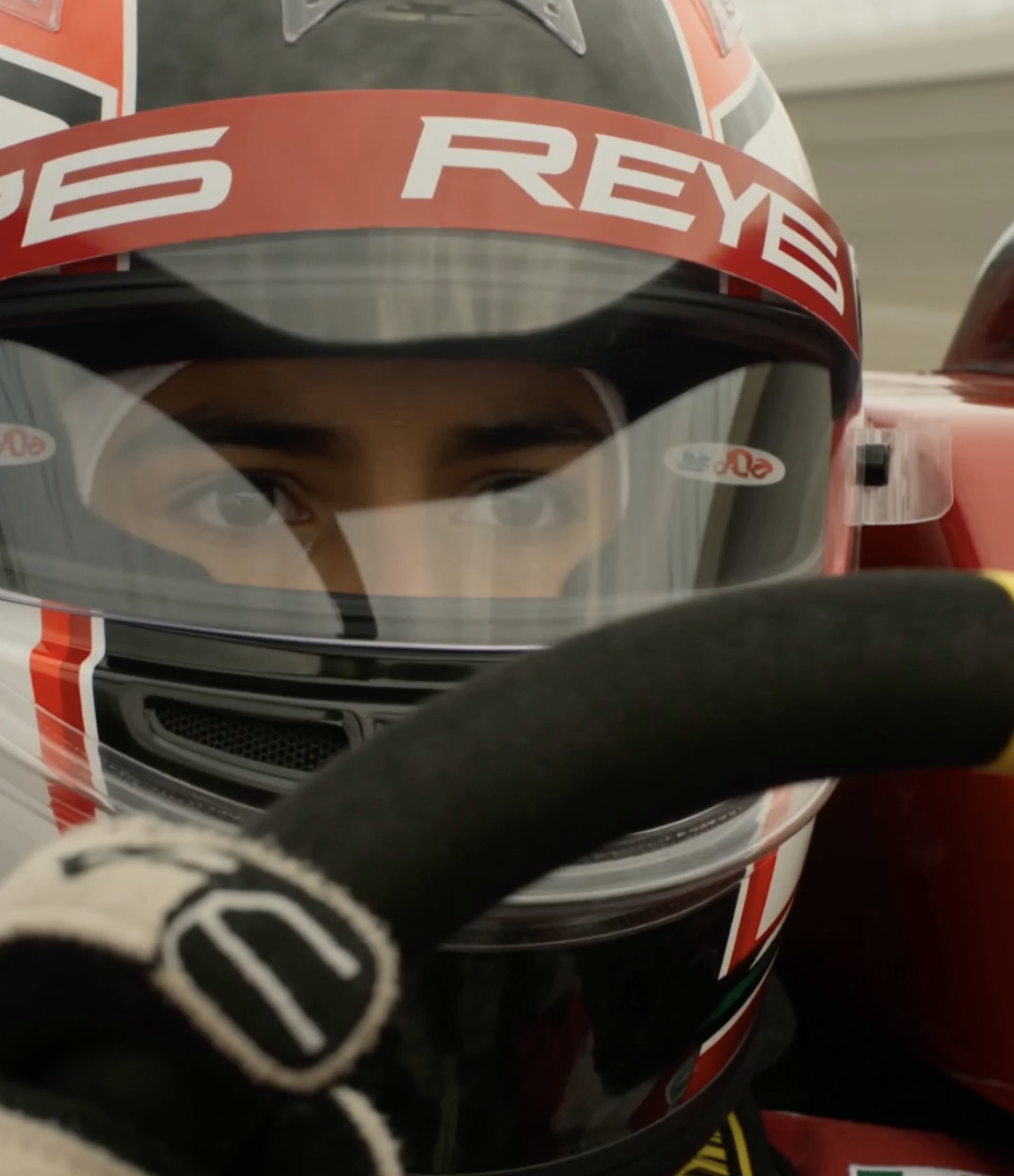
She crossed the finish line 0.018 seconds ahead of Tyler Cunningham.
It was the closest finish in the history of the F4 US Championship.
What She Said To Diego
The post-race garage at the Sebring International Raceway paddock on the evening of October 6, 2024 was, for the first eleven minutes after the finish of the championship race, the loudest place either Diego or Sloane Reyes had ever been in their professional lives.
Other teams were celebrating their own season’s results. Photographers were swarming the front of the Reyes Racing motorhome. Three different television production companies were trying to set up interview lights in spaces that were already too small for them. The PR director of the F4 US Championship was attempting, without much success, to corral the new champion into a press conference that was scheduled to begin in eleven minutes.
Diego had told the PR director that his daughter would attend the press conference. He had also told her, politely, that she had thirteen minutes to wait, because his daughter had something she needed to do first.
Sloane had walked into the garage area where her car had been parked.
She had still been in her racing suit. She had been carrying her helmet under her arm. Her eyes had been red from the heat inside the cockpit and from the wind on the cool-down lap and from one other reason she had not, at that moment, allowed herself to look at directly.
She had walked up to her father.
Diego had been standing beside the car. He had been holding a small piece of paper.
Sloane had said, in Spanish, quietly:
“Mamá habría estado orgullosa, Papá.” (“Mom would have been proud, Papa.”)
Diego had said, in English: “She was watching.”
Sloane had said: “You think so?”
Diego had said: “Sloane. Your mother spent six years and seven months on this earth after the morning you won your first national championship. She spent every one of those days, including the ones in the hospital at the end, telling me one thing about you. And that thing was: do not let her stop. Do not let the world tell her she can’t. Do not let her think for one minute that what she has is anything less than what it is. I have been holding onto that for six and a half years, Sloane. Today, you won. That is what your mother spent the last seven months of her life trying to make sure happened. So yes. I think she was watching. I think she has been watching every weekend for six years. And I think this afternoon, in that last corner, she was the only one who was not surprised.”
Sloane had said: “Papa.”
Diego had said: “What.”
Sloane had said: “Te amo.”
Diego had said: “Te amo, mija.”
They had embraced, for the first time that afternoon, in front of the small section of camera crews who had managed to get into the garage. None of the photographs from that moment have ever been released by the family. The photographers had been told, by Diego, in his quiet polite firm voice — the voice he used when something mattered — that the photographs of that particular embrace were not for sale, and would not be authorized for any commercial use, at any price.
The photographers had respected the request.
In the eighteen months since, none of the photographs from that moment have ever appeared in any motorsport publication.
The only known photograph of Sloane and Diego Reyes embracing in the garage at Sebring on the evening of October 6, 2024 hangs in the office of Reyes Performance, in a simple wooden frame, on the wall above Diego’s desk, where it can be seen by approximately forty customers per week and by no one else.
What Came After
In November of 2024, six weeks after the F4 US Championship final, Sloane Reyes signed a multi-year development contract with Williams Racing Driver Academy.
She was, at the time of the signing, the youngest driver in the fifteen-year history of the Williams Driver Academy. She was also the first driver of Mexican-American background ever signed by any Formula 1 team’s development program.
The contract paid for her 2025 season in F3 in Europe. It paid for her relocation to the team’s training facility in Grove, Oxfordshire. It paid for the relocation, at Sloane’s specific contractual request, of her father, who agreed — after several long conversations with his daughter and with the manager of his Peoria repair shop — to close Reyes Performance temporarily and to spend the next four years in England working as a consultant to the Williams junior team and as the only person on earth Sloane Reyes had ever fully trusted to look at her race car between sessions.
The shop in Peoria has not been closed. Diego sublet it to a former employee. He intends to reopen it in 2030, when Sloane is twenty-three and, by every reasonable projection of her current trajectory, will either be racing in Formula 1 or will have established herself in IndyCar.
Sloane finished the 2025 F3 season in fourth place in the championship. She won three races. She is, at the time of this writing in the spring of 2026, considered by the European motorsport press to be the most likely candidate to become the first full-time female Formula 1 driver since Lella Lombardi raced for Brabham in 1976.
Her first opportunity, by the most credible reporting, will come no earlier than 2028.
She will be twenty-one years old.
What Esperanza Knew
Esperanza Reyes had been an accountant.
She had not been a person, by her own description, who believed in things that could not be proven by ledger entries.
She had, however, written a letter on the morning of her diagnosis in October of 2018, that she had given to Diego with explicit instructions not to open it until Sloane had won a national-level championship in a real race car.
Diego had honored those instructions for six years.
He had opened the letter on the morning of October 7, 2024 — the morning after Sloane had won the F4 US Championship.
The letter had been one page long. It had been written in Esperanza’s careful left-handed cursive, in blue ballpoint pen, on a sheet of letterhead from the dental practice where she had worked.
It had said:
“Diego.
If you are reading this, our daughter has won a championship in a real race car.
I am writing this on the morning my doctor told me I have less than four months to live. I have four hours alone in the house before Sloane comes home from school. I am writing this in those four hours because I do not want you to have to remember to write down what I think about this. I want you to have it in my own handwriting.
She is going to win. I have known this since she was six years old. You have known it too. You just did not believe what you knew.
She is going to win because she has the thing you have called cabeza para correr, and she has the thing I have called the calm. She is the only seven-year-old I have ever met who has both. Most of the racing drivers you have admired in our lives have had one or the other. She has both. She does not know this yet. Do not tell her. Let her find it out the way she finds everything out, which is by doing it.
When she wins her first big race — and she will, Diego, I have known this since the morning she was born and I am not afraid of being wrong about this — I want you to do three things.
One. Do not put my name on any sticker, on any car, on any uniform. She is not racing for me. She is racing for herself. I do not want my death to become her motivation. That is not love. That is a debt. Children should not race in debt to their dead mothers.
Two. Do not let her thank me at any press conference, in any interview, in any social media post. The thank-you is the winning. You and I have already had this conversation. I am writing it down so you remember it.
Three. Tell her, on the night of her first big win, that I knew. Not that I would have been proud. Not that I would have wanted to be there. But that I knew. I knew on the morning she was born, Diego. I held her in the hospital and I looked at her face and I knew. I have not told you this because you would have thought I was being sentimental. But I was not being sentimental. I was being an accountant. I have been keeping track of her my entire life. The numbers were always there. She was always going to do this.
Thank her for proving me right.
Te amo, mi corazón. Both of you.
— Esperanza.”
Diego had read the letter, alone in the kitchen of their Peoria house, on the morning of October 7, 2024.
He had walked upstairs to Sloane’s room, where she had been sleeping after the long drive home from Sebring the night before.
He had sat on the edge of her bed.
He had waited until she had woken up.
He had read her the letter.
When he had finished, Sloane Reyes — the new F4 US Champion, the seventeen-year-old daughter of a mechanic from Peoria, the future Williams Racing development driver, the most likely first female Formula 1 driver in fifty years — had said only one thing.
She had said:
“Read it to me again, Papa.”
Diego had read it to her again.
He has, in the eighteen months since, read it to her exactly four more times — on her eighteenth birthday, on the day she signed the Williams contract, on the night she won her first F3 race in Spielberg, Austria, and on the evening of her mother’s birthday in February of 2026.
The letter is now kept, in its original envelope, in a small fireproof safe in the front office of Reyes Performance in Peoria, Illinois, where it will remain until Sloane Reyes one day decides — or does not decide — what she wants to do with it next.
“The thank-you is the winning.
Thank her for proving me right.”
If this story moved you, share it with someone who needs to hear it.
Some mothers write letters on the mornings they are diagnosed with diseases they know they cannot survive, because they are accountants and they understand exactly what is on the other side of the ledger.
Some fathers spend twenty-two years training their daughters in gravel lots behind auto repair shops because they understand, in the quiet way working-class fathers sometimes understand things, that the only inheritance they have to give is the one their daughters cannot already buy for themselves.
And some seventeen-year-olds, in the last corner of the last race of the last season they will ever race against teams that have four million dollars and they do not, take the outside line — because their fathers told them to, because their mothers knew they would, and because no one had ever tried it before, and someone had to.