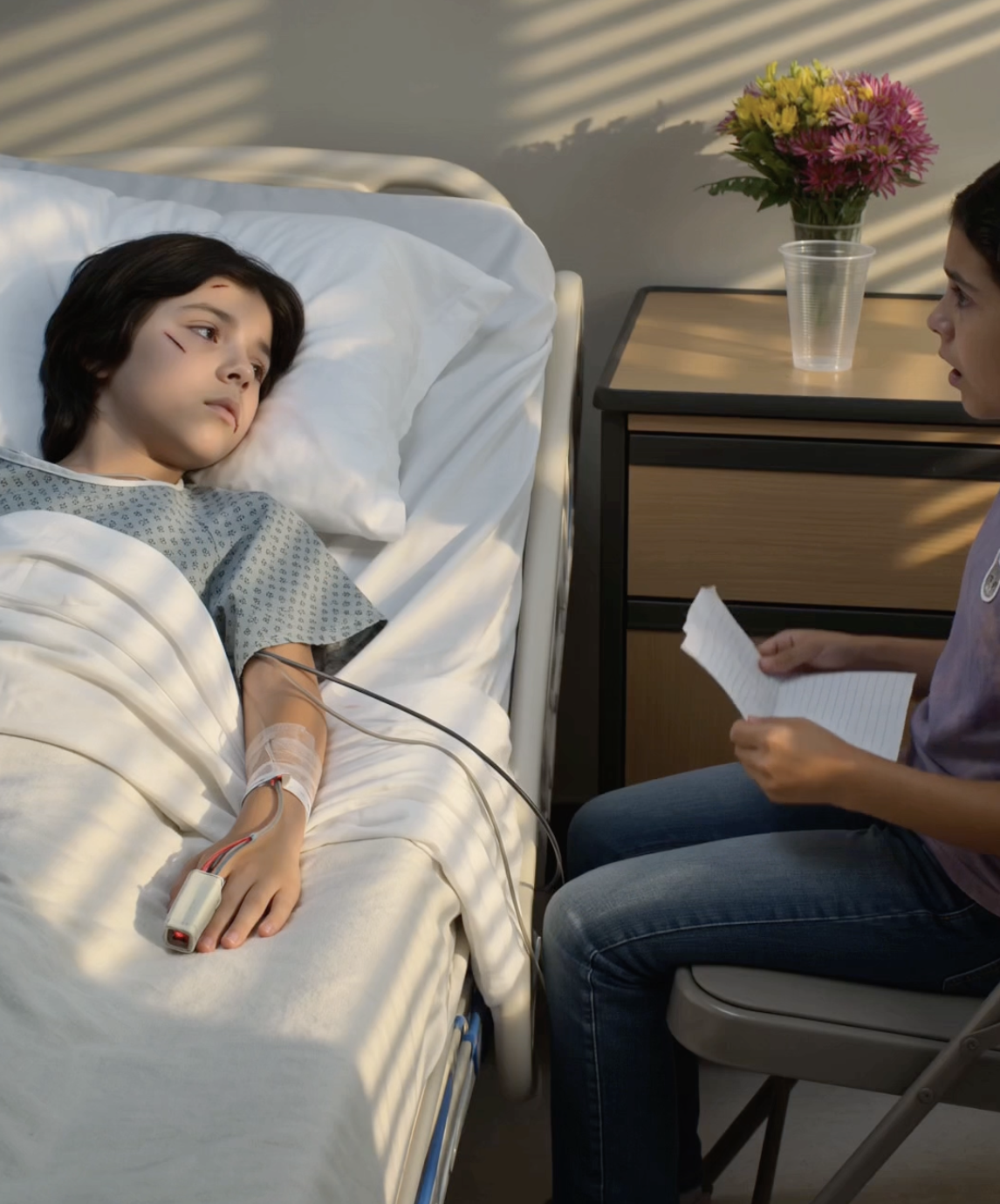
What a nine-year-old in Phoenix decided to do when the doctors told her parents to prepare — and what happened on the afternoon she finished her last letter
Luis Ramirez was eleven years old when he fell off his bicycle on the morning of February 14, 2024.
He was riding to his middle school in central Phoenix. It was a Wednesday. There had been an unusual frost the night before — the kind of frost that almost never comes to that part of Arizona, the kind that takes everyone by surprise because none of them have learned, in their lives in the desert, to think of black ice as something that can happen on a residential street.
He hit a patch of it on the curve of Bethany Home Road.
His front wheel slid. He went over the handlebars. He landed on the right side of his head against the curb.
He was wearing a helmet. The helmet, which his mother had bought him three weeks earlier for his eleventh birthday, did exactly what helmets are designed to do, which is to absorb the energy of an impact that would otherwise have killed him.
It did not, however, prevent the impact from causing what the neurologists at Phoenix Children’s Hospital would later call a severe diffuse axonal injury with secondary brainstem swelling.
Luis was unconscious when the paramedics arrived four minutes after his classmate, a thirteen-year-old girl named Daniela, called 911 from her flip phone in the bike lane.
He was still unconscious when his parents — Roberto, a forty-one-year-old crew supervisor for a solar installation company, and Cecilia, a thirty-eight-year-old dental hygienist — arrived at the hospital seventy minutes later.
He had not, at the time of this story, regained consciousness in five months and twelve days.
The doctors had been telling Roberto and Cecilia, for the previous six weeks, that the probability of Luis emerging from his current state was, in the precise clinical phrase of the senior neurologist on his case, “declining at a rate that we need you to begin to plan around.”
They had used many other phrases. They had said “persistent vegetative state.” They had said “the window is closing.” They had said “five months is the threshold we look at in cases like this.”
Roberto and Cecilia had nodded. They had understood. They had begun, in the careful private way parents do when they are being asked to do something they cannot allow themselves to fully feel yet, to plan around it.
They had not, however, told their daughter.
Their daughter’s name was Maya.
Maya Ramirez was eight years old on the morning of February 14, 2024.
She was nine years old by the time the doctors started using the word window in conversations with her parents.
She had been the one — though no one in the family except her would later remember this, because nine-year-olds who become responsible for things their parents have not asked them to be responsible for tend to do so quietly — who had decided, on the afternoon of February 16, 2024, two days after her brother’s accident, that she would write him a letter.
Why She Started
Maya had asked her mother, sitting on the floor of Luis’s empty bedroom on that Friday afternoon, whether Luis could hear them.
Cecilia had said: “The doctors don’t know, sweetheart. Sometimes people in comas can hear. Sometimes they can’t. We don’t know for sure.”
Maya had said: “But we don’t know that he can’t hear.”
Cecilia had said: “No, sweetheart. We don’t know that he can’t.”
Maya had thought about this for a long time. She had been sitting on the rug in the middle of Luis’s room. Luis’s cat, Bandit — a large gray tabby Luis had begged for and gotten on his eighth birthday, an animal who had, by every measure that mattered to the rest of the family, considered Luis to be his only legitimate human companion since the day they had brought him home — was sitting on Luis’s bed, where he had been sitting almost continuously since Luis had been taken to the hospital.
Maya had looked at Bandit.
She had said, to her mother: “Bandit doesn’t know where Luis is.”
Cecilia had said: “I know, sweetheart.”
Maya had said: “Someone should tell him.”
Cecilia, who had not cried in front of her daughter in two days because she had decided that her daughter had already cried enough for both of them, had said: “I don’t know how to tell a cat, sweetheart.”
Maya had said: “I can write Luis a letter and read it to Bandit. Then when Luis wakes up I can read all the letters to him so he knows what happened while he was sleeping.”
Cecilia had said, very carefully: “That’s a lovely idea, sweetheart.”
Maya had said: “It’s not lovely. It’s just necessary.”
Maya had written the first letter that evening, at the kitchen table, on a sheet of lined notebook paper she had torn out of her own school binder. She had written it in blue ballpoint pen, in the careful third-grade cursive she had only recently learned and was, by her own private assessment, not yet good at.
The letter had been four sentences long.
It had said:
“Dear Luis. You fell off your bike. You are at the hospital. Bandit is sad. We miss you. Love, Maya.”
She had read it to Bandit that night before bed.
Bandit had purred.
She had read it to Luis the next afternoon, at the hospital, sitting in the folding chair her father had placed beside the bed.
Luis had not moved.
She had decided, that evening, that she would write a new letter every day until Luis woke up.
She did not, at that time, know how many days that would be.
She had assumed it would be a few weeks at most.
The First Hundred Letters
For the first month, Maya wrote her letters at the kitchen table after dinner.
Her letters in the first month were short — usually four or five sentences, the way the first one had been. She wrote about what she had done at school. She wrote about what Bandit had done. She wrote about what their mother had cooked.
By the second month, the letters had begun to grow longer.
By the second month, Maya had begun to understand — in the way nine-year-olds understand things their parents are very deliberately not telling them — that Luis was not, in fact, going to wake up in a few weeks.
She had not asked her parents about this.
She had asked, instead, the nurses.
Her favorite nurse on Luis’s floor was a woman named Brenda, a forty-something Filipina with two grown sons and a tendency, when she was charting at the desk, to hum old Tagalog love songs under her breath. Brenda had been a pediatric ICU nurse for nineteen years. She had been Luis’s primary nurse on the day shift for the last three months. She had developed, with Maya, the kind of relationship that adults sometimes develop with children whose seriousness exceeds their years and to whom they therefore find themselves speaking, almost without intending to, as if the child were an equal.
Maya had asked Brenda, one afternoon in early May, sitting at the nurses’ station after she had finished reading Luis his letter for the day: “How long do most people stay asleep?”
Brenda had set down her chart. She had thought about this for a moment. She had said: “It depends, mija. Some people wake up after a few weeks. Some after a few months. Some take a year. Some take longer.”
Maya had said: “Some don’t wake up.”
Brenda had said: “Some don’t wake up.”
Maya had said: “My parents are starting to think Luis won’t wake up.”
Brenda had said: “How do you know that?”
Maya had said: “Because my mom is buying his old clothes a second time. She did it last weekend. She bought him new socks. Then she went into his room and put them in his drawer like he wasn’t going to come home.”
Brenda had looked at Maya for a long moment.
She had said: “Mija. Sometimes parents do things because they are too sad to imagine the other thing happening.”
Maya had said: “What other thing?”
Brenda had said: “That your brother might still wake up.”
Maya had said: “Why would they be sad about that?”
Brenda had said: “Because hoping for something for a long time and then losing it is the kind of pain that some people, when they have lost too much already, decide they cannot survive a second time. So they stop hoping. It is a kind of protection.”
Maya had said: “That is stupid.”
Brenda had said: “It is not stupid, mija. It is just human.”
Maya had said: “I am still going to hope.”
Brenda had said: “I know, mija.”
Maya had said: “And I am going to keep writing him letters until he wakes up.”
Brenda had said: “I know.”
Brenda had told this conversation to the senior nurse on her floor that evening, after Maya had gone home. The senior nurse had told it to the day’s attending physician at the morning handoff the next day. The story of Maya Ramirez and her letters had begun, by mid-May 2024, to be known to almost every staff member who worked on the third floor of the pediatric wing of Phoenix Children’s Hospital.
It was not, however, told to Maya’s parents.
Brenda had decided this herself.
She had said, when the senior nurse had asked her why, only: “She does not need them to know. She needs them not to know. That is the point of what she is doing.”
The senior nurse had not asked any further questions.
What Was In The Letters
By the fourth month of Maya’s writing, the letters had become the kind of document that an adult, reading them, would have understood as something far more complex than a child’s casual correspondence with an absent sibling.
They had become a daily record of an entire family.
Maya had begun, by the third month, to write about things that her parents thought she had not been noticing.
She had written about her mother’s crying.
She had written about her father’s drinking.
She had written about the argument her parents had had on the night of April 22, 2024, after they had come home from a long meeting with the social worker assigned to Luis’s case — an argument she had heard through her bedroom wall, in which her father had said something to her mother in Spanish that Maya had not quite been able to make out, and her mother had screamed back something in Spanish that had ended with the word bastante, which Maya knew meant enough.
She had written:
“Luis. Mom and Dad fought tonight. I think Dad said something he wishes he had not said. Mom told him bastante. I don’t know what they fought about. Maybe it was you. I think it was you. They love you. I know they do. They are just very tired. Maybe when you wake up they will not be so tired anymore.”
She had written about her own school.
She had written about a girl in her class named Tessa who had told Maya, in the cafeteria one Tuesday in April, that Maya’s brother was probably going to die soon. Maya had written:
“Luis. A girl named Tessa told me you were going to die. I told her she was a stupid pendeja. I am not supposed to say that word. But I said it. She cried. Mrs. Patterson sent me to the principal. The principal called Mom. Mom did not yell at me. She cried in the car on the way home. I am sorry I made Mom cry. But I am not sorry I called Tessa a pendeja. She deserved it. I will not write that word again, Luis. But I want you to know it happened.”
She had written about Bandit, who was — by the fifth month — sleeping under Luis’s bed almost continuously, except for short trips to his food bowl and his litter box.
She had written about her own homework, which she had been doing badly, because she had been spending most of her afternoons in the hospital.
She had written about Luis’s homework, which she had been doing for him. Not because anyone had asked her to — Luis was, of course, not enrolled in school during his coma — but because she had decided, sometime in the third month, that he was going to wake up and would have to catch up on everything he had missed, and she did not want him to be embarrassed when he returned to seventh grade in the fall.
She had been keeping a separate notebook in which she had been completing Luis’s seventh-grade math homework — every assignment, every worksheet, every textbook problem — in his name, in handwriting she had carefully practiced to imitate his.
She had been doing this on top of her own third-grade math homework, which she hated.
Luis loved math.
She did not.
She was doing it for him anyway.
What She Wrote On The Last Day
On the afternoon of July 31, 2024 — a Tuesday, the 167th day since Luis had fallen off his bike on Bethany Home Road — Maya arrived at the hospital at 4:17 PM after her last day of summer school.
She was carrying her folder of letters.
The folder, by that point, contained 166 letters. Each one was folded in thirds and held in place by a blue rubber band. The folder itself was a faded purple plastic accordion folder that Maya had originally been given by her third-grade teacher to hold reading assignments. She had emptied it of reading assignments in February. It had held nothing but Luis’s letters since then.
Maya sat down in the folding chair beside Luis’s bed.
She unfolded the letter for the day.
It was a longer one than usual. She had written it in two sittings the night before — once before dinner and once after — because there had been something specific she had wanted to tell Luis.
The letter was about Bandit and a cactus.
Their mother had bought a new cactus, the previous Saturday, for the front living room window. It was a small barrel cactus in a terracotta pot. Cecilia had not had a houseplant in five months. The purchase of the cactus had been, in the careful private assessment of every adult in the family, the first time their mother had bought anything for the house that was not strictly necessary since the morning of February 14.
Maya had understood, when her mother had carried the cactus into the house, what it meant.
She had not said anything to her mother.
Bandit had also understood, in the way cats understand things humans assume they do not, that something in the household had shifted. He had stalked into the living room within twenty minutes of the cactus’s arrival. He had stared at it from across the room for several minutes. He had then walked over to it, lifted his right front paw, and pushed the terracotta pot — slowly, deliberately, the way a cat pushes something that is on a table when it has decided that the thing in question should not be there — off the windowsill and onto the floor.
The pot had shattered.
Cecilia had been in the kitchen.
She had come into the living room. She had looked at the broken pot, the spilled soil, the cactus on its side, and the cat, who by that point had already retreated to his preferred position under Luis’s bed.
She had stood there for several seconds.
Then she had started laughing.
She had laughed for almost a full minute. Maya, who had been watching from the hallway, had not seen her mother laugh like that since before the accident. Cecilia had eventually stopped laughing, had wiped her eyes, had picked up the cactus, had repotted it in a coffee mug because she did not have another terracotta pot, and had put it back on the windowsill.
She had not punished Bandit.
She had not, in fact, mentioned what had happened to anyone except Maya, who had been right there.
Maya had written about it that night.
She had written:
“Luis. Bandit knocked over Mom’s cactus. He was scared. He hid under your bed. He’s still under your bed, Luis. He’s waiting for you too. We’re all waiting for you. We can wait as long as you need. But Bandit is getting fat from worry and Mom is mad about the cactus. Mom is not really mad. She laughed when it fell. She laughed for a long time, Luis. It was the first time I heard her laugh since you got hurt. I think Bandit knocked it over for her. I think Bandit knew. Cats know things. You always told me that. I did not believe you. I believe you now. I love you, Luis. Please come home. Love, Maya.”
She read this letter to Luis on the afternoon of July 31, 2024, in the folding chair beside his bed, at 4:47 PM Mountain Standard Time.
She read it slowly.
She had been reading slowly for months.
She got to the line about Bandit getting fat from worry.
She made a small almost-laugh at the end of that sentence — the first non-sad sound her voice had made in the hospital room in several weeks.
She paused.
She began to fold the letter back along its three creases.
She glanced up at her brother — the way she had glanced up a thousand times, in the past 167 days, expecting nothing.
Her brother’s eyes were open.
He was looking at her.
What Happened Next
Maya did not, in the seconds immediately after she realized that her brother’s eyes were open, do any of the things a more dramatic version of this story would have her do.
She did not scream.
She did not cry out for the nurses.
She did not stand up from her chair.
She sat very still, holding the half-folded letter in her lap, and she stared at her brother, and her brother stared back at her, and neither of them said anything for what the security camera footage from the hospital room would later confirm was forty-seven seconds.
At the forty-eight-second mark, Maya said:
“Luis.”
Her brother, who had not been able to focus his eyes fully and who was — although she did not know this yet — going to need approximately eleven minutes before he was able to make any kind of vocal sound at all, said nothing.
But he blinked.
He blinked once, slowly. Then again. Then again.
Maya understood — in the way nine-year-olds who have written one hundred and sixty-seven letters to a sleeping brother understand things — that he was trying to tell her something.
She said: “You can hear me?”
He blinked once.
She said: “You can see me?”
He blinked once.
She said: “Do you know who I am?”
His eyes filled with tears.
He blinked.
Once.
Maya stood up from the folding chair very slowly, because she did not want to do anything sudden that might cause her brother to close his eyes again. She walked, equally slowly, to the door of the hospital room. She opened the door. She looked into the hallway.
Brenda was at the nurses’ station, twenty feet down the hall, charting.
Maya said, in a voice that was perfectly calm and only slightly higher than her usual speaking voice:
“Brenda. Luis is awake.”
Brenda looked up.
She looked at Maya.
She did not immediately move.
Maya said, in the same calm voice: “He’s looking at me, Brenda. He blinked at me. He’s awake.”
Brenda set down her chart.
She walked, then ran, the twenty feet to Luis’s room.
When she entered the room, Luis Ramirez — who had not been conscious in any meaningful clinical sense for five months and seventeen days — was looking directly at his sister, who had walked back to her folding chair and had sat down in it and had taken his right hand in both of hers, and was crying silently while he blinked at her in a slow regular rhythm.
Brenda paged the attending neurologist.
She paged Cecilia and Roberto, both of whom were at work.
Cecilia arrived at the hospital twenty-two minutes later.
When Cecilia walked into the room, Luis — who by that point had managed to make his first small vocal sound, a kind of dry breathy ahh that was the most beautiful thing his sister had ever heard — turned his head approximately fifteen degrees toward the door.
He looked at his mother.
She fell to her knees on the linoleum floor.
She did not stand up for a long time.
What Came After
Luis Ramirez’s recovery from his diffuse axonal injury was, by the assessment of his neurology team and the broader medical literature on traumatic brain injury, statistically remarkable but neurologically explicable.
He spent four additional months in the hospital.
He underwent eight months of intensive physical and occupational therapy.
He returned home to his family’s house in central Phoenix on December 14, 2024.
He returned to school — repeating sixth grade, because the cognitive and physical demands of seventh grade were judged to be too much for his recovering brain — in February of 2025.
He is, at the time of this writing, fourteen years old.
He has some persistent deficits.
He is slower in conversation than he was before. He forgets names more often than other children his age. He cannot, his mother has explained, ride a bicycle anymore. The motor pathways involved have not fully recovered, and the neurologists have advised the family that the risk of a second injury would be unacceptable given the residual swelling that remains, faintly visible, on his most recent MRI.
He can run.
He can play soccer.
He can read at grade level.
He can do, his mother says, almost everything else that boys his age can do.
He is alive.
His mother considers this, every morning when he comes downstairs for breakfast, to be sufficient.
His father considers this, every morning when he watches Cecilia watch Luis come downstairs for breakfast, to be more than sufficient. He considers it, in his most private and unspoken assessment, to be a miracle.
Roberto Ramirez is not, by his own description, a religious man.
He has begun, since December of 2024, to attend Mass with his family on Sunday mornings.
He has not told his wife why.
She has not asked.
What Maya Has
Maya Ramirez is, at the time of this writing, ten years old.
She is in fifth grade.
She still writes letters to her brother.
She does not write them every day anymore. She writes them when something specific happens — something that she wants to make sure Luis hears about, in her own words, in the way she has been telling him things for most of her life now.
She has written him a letter, in the last eighteen months, on:
The day Bandit died — peacefully, in his sleep, on the rug in Luis’s bedroom, on April 9, 2025, at the age of nine.
The day her father got his promotion at the solar company.
The day Tessa Patterson, the girl who had told Maya in the cafeteria that Luis was going to die, transferred to a different school.
The day Maya’s grandmother — her abuela in Sonora — was diagnosed with breast cancer.
The day her abuela’s surgery was successful.
The night before her brother’s first day of seventh grade — which he started, finally, in the fall of 2025, one full school year behind his original cohort.
The night her brother won a school chess tournament.
The night her brother had his first kiss, which he had told her about in confidence, and which she had then written to him about in a letter that she had not given him, because she had wanted to write it for herself, and because she had wanted there to be a record, somewhere, of the day her brother had been alive enough and well enough to do something that had absolutely nothing to do with his accident or his coma or the five months and seventeen days he had been gone.
She keeps the letters — all of them, the original 167 from the coma period and the new ones since — in the same faded purple plastic accordion folder.
The folder lives on the bookshelf in her bedroom, beside a small framed photograph of her and Luis at her seventh birthday party, and a single dried sunflower that her brother had given her, the previous summer, for her tenth birthday.
When her mother had asked her, in the spring of 2025, why she still kept all the old letters from the coma period instead of throwing them out now that Luis was awake, Maya had said:
“Because I do not want to forget what it was like to talk to him when I did not know if he could hear me.”
“Because the letters worked.”
“Because I do not know how I knew that they were working. I just knew.”
“And because, when I have my own children someday, and one of them gets hurt the way Luis got hurt, I want them to know that their tía Maya wrote her brother letters every day for one hundred and sixty-seven days and that on the one hundred and sixty-seventh day he woke up.”
“I want them to know that talking to someone who cannot answer you back is not the same thing as talking to no one.”
“I want them to know that sometimes, when a person is far away from you in a way that nobody understands, the only thing you can do for them is to keep talking to them as if they were close. And to keep doing it every day. And to not stop. Even when other people tell you to stop. Even when you are very tired. Even when the cat under the bed is the only one in the house who still believes you.”
Maya had paused, after that, in the way she paused when she was deciding whether to add a final sentence.
She had added it.
She had said:
“Cats know things, Mom. They know things we don’t.”
“Talking to someone who cannot answer you back
is not the same thing as talking to no one.”
If this story moved you, share it with someone who needs to hear it.
Some children write letters every day for one hundred and sixty-seven days because no one has told them they should stop.
Some cats sleep under the beds of children who are not yet home, because they know — in the way cats know — that the children are coming back.
And some sisters, when they are nine years old, are already braver and more patient and more stubborn than the adults around them will ever fully understand.