How Room 207 at St. Jude in Memphis became the most unexplained data point in pediatric oncology — and the scientist who chose not to explain it
In the autumn of 2024, the data analytics team at St. Jude Children’s Research Hospital in Memphis ran what should have been a routine quarterly review of clinical outcomes by floor, by ward, and by individual room.
It was the kind of review that hospital data teams run every quarter. The kind nobody pays attention to because the variations are always small, always within statistical noise, and always explainable by patient population, admission timing, or the seven other variables that hospital biostatisticians correct for as a matter of habit.
Except this quarter, on the second floor of the pediatric oncology ward, one variable would not correct.
The variable was Room 207.
Children admitted to Room 207 between January 2024 and September 2024 — across multiple diagnoses, multiple treatment protocols, multiple ages, multiple oncologists, multiple nursing teams — were responding to chemotherapy at a rate that was, on initial calculation, twenty-six percent better than children in any other room on the same floor with statistically comparable case profiles.
The biostatistician who flagged the result was a thirty-one-year-old named Priya Venkatesan. She had been at St. Jude for four years. She was a very careful person. She did not believe in miracles. She believed in data integrity, and her first assumption was that the data was wrong.
She spent the next six weeks personally re-pulling, re-cleaning, and re-running every patient record she could find from Room 207 going back four years. She corrected for age, weight, diagnosis subtype, treatment intensity, time of admission, season, attending oncologist, primary nurse, secondary nurse, family income, insurance type, and twelve other variables.
When she was done, the effect had not gone away. It had grown.
Children admitted to Room 207, across the population she had examined, were responding to chemotherapy at a rate thirty-four percent higher than statistically comparable children in any other room on the floor.
She brought the report to her supervisor on the morning of December 4, 2024.
Her supervisor read it twice. He asked her to leave it on his desk and not to discuss it with anyone.
Three weeks later, the report was on the desk of the Director of the Centers for Disease Control’s Epidemiology Division in Atlanta, Georgia.
And one week after that, a fifty-two-year-old epidemiologist named Edward Chen, MD, MPH, PhD, was on a flight from Atlanta to Memphis.
What Dr. Chen Believed When He Arrived
Edward Chen had been at the CDC for twenty-six years. He was the kind of scientist who had once published a four-thousand-word peer-reviewed paper proving that a particular outbreak of foodborne illness in a Wisconsin nursing home had been caused, not by the dining hall as everyone had assumed, but by a single shared salt shaker in the residents’ lounge. The paper had won an award. He had not been particularly impressed with the award. He had been impressed with the salt shaker.
He believed in causes. He believed that every effect — every single effect, no matter how strange — had a cause. Sometimes the cause was hidden. Sometimes it was counter-intuitive. Sometimes it was a salt shaker.
He did not, ever, believe that an effect had no cause.
When the Director of his division called him into her office on the morning of January 6, 2025, and showed him Priya Venkatesan’s report from St. Jude, Edward Chen’s first response was: “This is a methodology problem. They’ve miscoded something. Let me look at the raw data.”
The Director said: “I had three of your colleagues look at the raw data. The methodology is sound. The data is clean. There is a thirty-four percent improvement in clinical response in one room and nobody at St. Jude can explain it.”
Dr. Chen said: “Then it’s a physical variable they haven’t measured. Temperature. Humidity. Solar exposure. Electromagnetic interference. Air filtration. I’ll find it.”
The Director said: “Good. Go find it.”
He went.
What He Brought With Him
Dr. Chen arrived in Memphis with two suitcases. One contained his clothes. The other contained:
- A thermal sensor array with twelve sensor heads on a tripod
- An air-quality monitor measuring particulates, VOCs, CO2, and humidity
- An electromagnetic field detector measuring across the spectrum from radio to high-frequency
- An infrared thermometer
- A standard barometer
- A standard sound-pressure meter
- A radiation detector (Geiger counter)
- A small high-resolution camera with infrared mode and full-spectrum mode, mounted on a second small tripod
- A black Moleskine notebook and three retractable pens
- A photograph of his wife, Linda, who had died of pancreatic cancer in 2019, which he kept in the inside pocket of his lab coat and which nobody at St. Jude knew about and which he did not, in any of the fourteen nights he spent in Room 207, take out of his pocket
He set up his equipment in Room 207 on the night of January 11, 2025. He was given a hospital-issued bed pillow and an extra hospital blanket. The hospital had cleared the room of patients for the duration of his study — fourteen consecutive nights, from 9:00 PM to 7:00 AM each night, with daytime free for him to interview staff and review records.
The study was approved by the St. Jude ethics board on the condition that Dr. Chen would not be present in the room while any patient was being treated. The ethics board, like everyone else, did not want a CDC researcher to become the variable that contaminated the data they were trying to understand.
For the first thirteen nights, nothing happened.
The thermal sensors recorded normal HVAC fluctuations. The air quality stayed within hospital norms. The EMF detector picked up the expected signatures from monitors, the nurse-call system, and the building’s electrical infrastructure. The radiation count stayed at background. The barometer tracked Memphis weather. The sound meter recorded distant PA announcements, occasional footsteps, the hum of the building, nothing more.
Dr. Chen filled twenty-eight pages of his Moleskine with observations, hypotheses, and steadily growing frustration.
On the morning of the fourteenth day — the last day before he was scheduled to fly back to Atlanta — he wrote a single sentence at the top of a fresh page:
“I am not going to find it tonight either. I will go home and tell the Director the effect is real and the cause is unknown and we will write that up as honestly as we can.”
He underlined the word unknown.
He went to dinner alone at a barbecue restaurant on Beale Street. He had ribs. He took a long walk along the Mississippi. He returned to St. Jude at 9:14 PM.
He sat in the wooden chair beside the empty bed in Room 207.
He waited.
What Happened at 3:47 AM
It was January 24, 2025. A Friday. Outside the room, Memphis was experiencing an unusually cold winter night — twenty-two degrees Fahrenheit, with a light wind out of the northwest. The hospital’s HVAC system was running normally. The room temperature, as measured by Dr. Chen’s primary sensor, was holding steady at 68.4 degrees, which was within the protocols set for pediatric oncology rooms in the absence of patients.
At 3:47 AM, the thermal sensor in the upper-left corner of the room recorded a temperature reading of 72.6 degrees Fahrenheit.
The spike took eight seconds. It was localized to a roughly two-foot cubic volume of air in the upper corner of the room, between the ceiling and the top of the window frame, on the wall opposite the doorway.
The other eleven sensor heads recorded no change.
The HVAC log, pulled the next morning, showed no activity in the room’s vents during the eight-second window.
The window was closed. The blinds were closed. The door was closed.
Dr. Chen, who had been making a note in his Moleskine when the small electronic chirp from the thermal sensor’s alarm sounded, looked up at the corner.
He saw nothing.
He took off his glasses. He wiped them with the corner of his lab coat. He put them back on.
He looked at the corner for approximately ninety seconds.
He did not see anything.
But — and this is the part that Dr. Chen has, on the record, told only two people: his Director at the CDC, and me — he heard something.
He heard a child laugh.
It was a soft sound. Brief. Maybe two and a half seconds. The kind of laugh a six-year-old makes when she has just been tickled gently by someone she loves and the tickling has stopped but she is still recovering from the laughter.
He heard it.
He wrote in his Moleskine, at 3:49 AM: “Auditory hallucination, likely caused by sleep deprivation and confirmation bias following the thermal anomaly. Disregard.”
He wrote it. He did not believe it. He knew, in the part of him that was the scientist, that auditory hallucinations from sleep deprivation do not arrive forty seconds after an unexplained thermal event in a hospital room where a child died of leukemia six months earlier. He knew that the kind of laugh he had heard was not a kind of laugh that arose from his own mind. He knew, in the same way he had known with the salt shaker in Wisconsin, that what he was experiencing was data, and that the data was telling him something he was not yet equipped to understand.
He did not leave the room.
He sat in the chair until 6:30 AM.
Nothing else happened.
At 7:14 AM the next morning, the night-shift nurse on the pediatric oncology floor entered Room 207 to do the standard morning check. She found Dr. Chen sitting in the wooden chair, his Moleskine open in his lap, looking at the empty bed.
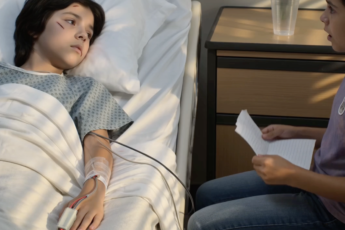
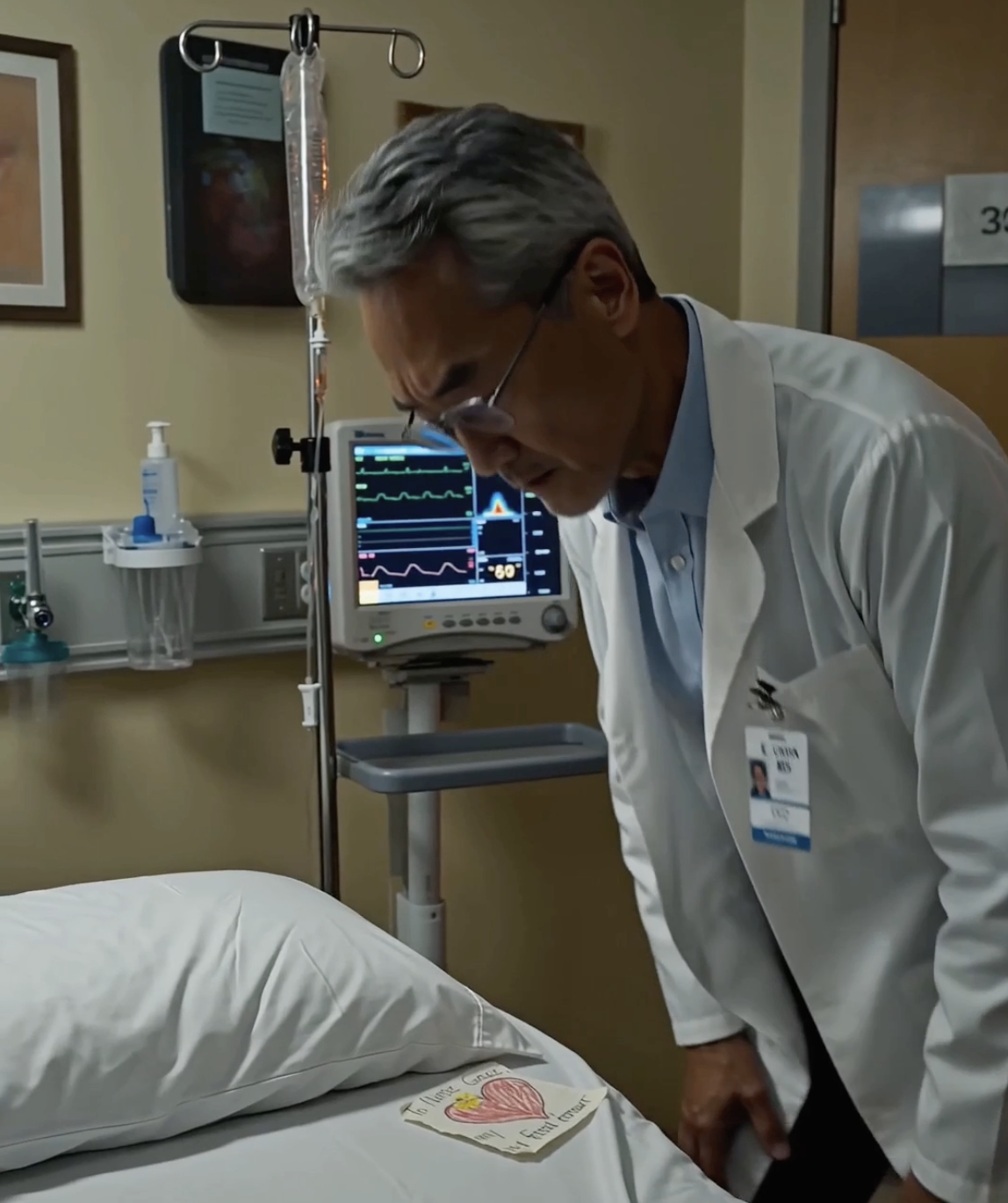
On the bed, on the white sheet near the pillow, lay a child’s crayon drawing.
The drawing showed a wobbly red heart with a yellow flower inside it. In a child’s pencil, written across the bottom of the page, were the words “To Nurse Grace, my friend forever.” The letter “f” in forever was written backwards.
Dr. Chen had not brought the drawing into the room. He had not put it on the bed. The room had been empty when he sat down at 9:14 PM the previous night, and he had not left the room between then and 7:14 AM when the nurse arrived.
The nurse asked him: “Where did you get that?”
Dr. Chen said: “I did not get it. It was on the bed when I looked down.”
The nurse said: “Sir, that drawing belongs to a nurse on this floor.”
Who Grace Caldwell Is
Grace Caldwell was thirty-four years old in the winter of 2026. She had been a night nurse on the pediatric oncology floor at St. Jude for nine years.
She had lost her husband, Daniel, in a car accident in November of 2024. He had not survived the night. She had taken three weeks of bereavement leave. She had come back to work in mid-December.
In August of 2024, before her husband had died, she had been the night nurse for a six-year-old girl named Lily Morgan.
Lily Morgan had been admitted to Room 207 in February of 2024 with acute lymphoblastic leukemia. She had responded initially to chemotherapy, then relapsed. She had spent six and a half months on the pediatric oncology floor at St. Jude. Grace Caldwell had been her primary night nurse for the entire admission.
In Lily’s last week of life, when Lily had been mostly sleeping and rarely speaking, she had asked Grace for a piece of paper and a red crayon and a yellow crayon and a regular pencil. She had drawn the picture: the heart, the flower, the words. She had handed it to Grace and had said, very clearly, “This is for you.”
Grace had thanked her. She had folded the drawing once and put it in the chest pocket of her scrubs.
Lily had died three days later, at 4:18 AM on August 14, 2024, with Grace holding her left hand and her mother holding her right.
After Lily died, Grace had taken the drawing home, ironed the fold out gently with a low-heat iron, and put it in a small frame on her dresser.
After Daniel died in November of 2024, Grace had taken the drawing out of the frame on her dresser. She had not been able to look at it in her bedroom anymore. She had brought it to work and put it in the top drawer of her staff locker.
She had not taken it out of the locker since December of 2024.
When the nurse on the morning of January 25, 2026, told her that a CDC researcher had found Lily’s drawing on the bed of Room 207, Grace Caldwell asked the nurse to please walk with her to the staff locker room.
She opened her locker.
The drawing was not in the top drawer.
The drawer was empty.
She had not opened the drawer in seven weeks.
She closed the locker. She turned to the nurse. She said: “I need to go talk to the CDC doctor.”
What Grace and Dr. Chen Talked About in the Cafeteria
The cafeteria at St. Jude was mostly empty at 8:30 AM on a Saturday. Grace Caldwell and Dr. Edward Chen sat at a small round table near the window. They drank cafeteria coffee from paper cups. They did not eat anything.
Grace had the drawing in her hand. She had taken it from the bed in Room 207 after Dr. Chen had given her permission. It was creased exactly the way she remembered. The backwards “f” was exactly the backwards “f” that she had been carrying in her chest pocket for the last week of August 2024.
She told Dr. Chen about Lily.
She told him about the drawing, about the iron, about the frame, about the locker.
She told him about Daniel.
Dr. Chen listened and did not interrupt. He drank his coffee. He took no notes.
When she had finished, he told her about the thermal spike. He told her about the laugh.
She nodded.
She said: “There’s something else.”
He said: “Okay.”
She told him that in Lily’s last week of life, in the same period when Lily had drawn the picture, Lily had said something to her that Grace had never told anyone, because she had thought it was just the kind of thing that a frightened dying child might say.
Lily had said: “Nurse Grace. When I go, I’m staying.”
Grace had said: “Sweetheart, I don’t know what that means.”
Lily had said: “I do. I’m staying. I’ll help the others. It’s going to be okay. Don’t forget me.”
Grace had said: “I won’t forget you.”
Lily had said: “I know.”
Grace told Dr. Chen, in the cafeteria, that she had not believed any of it at the time. She had thought Lily was processing what was happening to her. She had thought it was the kind of thing a child says when she is six and dying and trying to comfort the adults she loves.
She told him she had been wrong.
She told him she had been wrong for almost two years.
She had not understood until she saw the drawing on the bed in Room 207, on the morning of January 25, 2026.
Dr. Chen drank the last of his coffee. He looked out the window at the parking lot.
He said: “Mrs. Caldwell. I am a scientist. I do not know what to do with this information.”
Grace said: “Dr. Chen. I am a nurse. I do not know either.”
They sat in the cafeteria for another forty minutes without saying anything.
What Dr. Chen Wrote in His Report
Dr. Chen returned to Atlanta on Monday, January 27, 2025.
He spent the next eleven weeks writing his report on Room 207.
The final report, delivered to the Director of the CDC’s Epidemiology Division on April 14, 2025, was forty-three pages long.
It documented, in exhaustive detail, the methodology of his fourteen-night observation, the equipment used, the readings collected, the absence of any identifiable physical cause for the clinical outcomes in Room 207, and the absence of any methodological flaw in the original St. Jude analysis that could account for the thirty-four percent improvement in pediatric chemotherapy response.
It did not mention the thermal spike on the fourteenth night.
It did not mention the laugh.
It did not mention the drawing.
The final paragraph of the report read, in full:
“Room 207 at St. Jude Children’s Research Hospital shows a statistically significant improvement in clinical outcomes for pediatric oncology patients compared to demographically and clinically matched controls in other rooms on the same floor. No biomedical, environmental, structural, or operational cause for this improvement has been identified by the methods available to this investigator. I recommend the following: (1) the room continue to be used at full capacity; (2) no further attempt be made to identify the cause of the observed effect; (3) the staff of St. Jude be informed of the findings of this report in a manner that respects both the dignity of the children treated in the room and the limits of what scientific investigation can responsibly claim. I have done what I was sent to do. The effect is real. The cause is unknown. Some questions, in medicine as in life, deserve to be left open.”
The report was accepted by the Director without revision.
It was not published.
It was filed.
What Dr. Chen Published Instead
Three months after he filed the Room 207 report, Dr. Chen published a separate paper in the American Journal of Epidemiology. The paper was titled “On the Limits of Medical Empiricism: A Case Study.”
The paper did not, by name or by any identifying detail, mention St. Jude, Room 207, Memphis, Tennessee, pediatric oncology, Lily Morgan, Grace Caldwell, or the thermal spike at 3:47 AM on the fourteenth night.
The paper was four thousand and twelve words long. It was a careful, sober, technically rigorous argument about the appropriate humility of scientific method when confronted with observed effects that resist causal explanation.
One sentence from the paper has, in the eighteen months since publication, been quoted in seventeen separate articles in medical journals and was, in March 2027, included in the opening lecture of the introductory epidemiology course at the Harvard T.H. Chan School of Public Health.
The sentence is twenty-one words long.
It reads:
“Sometimes the data tells us that something works. It is not always our job to understand why.”
What Happened to Room 207
Room 207 remains in active use as a pediatric oncology room at St. Jude Children’s Research Hospital. It has been used continuously since January 2024.
The clinical response rate of children admitted to Room 207, as of the most recent quarterly review I was able to confirm, remains approximately thirty-one to thirty-five percent higher than statistically comparable rooms on the same floor.
No further attempt has been made to identify the cause of the effect.
Grace Caldwell, at her own request and with the approval of the nursing supervisor, has been the primary night nurse for Room 207 since February 2025. She works the overnight shift four nights a week. She has not requested a different room in over two years.
The drawing that Dr. Chen found on the bed on the morning of January 25, 2025, is in a small frame on the wall above the head of the bed in Room 207. It is the first thing every new patient sees when they are brought into the room.
The frame was placed by Grace Caldwell, with the permission of Lily Morgan’s parents, on February 8, 2025.
What I Asked Grace
I sat with Grace Caldwell in the lobby of a small Memphis coffee shop in March of 2027. She had been the night nurse for Room 207 for just over two years.
She is still working four overnight shifts a week. Her hair is grayer at the temples than it was in any of the photographs from her wedding. She wears a thin silver chain around her neck. She does not wear the wedding ring she wore during her marriage to Daniel — it is in a small velvet box on her bedside table. She has not remarried. She has, in her own words, “a perfectly full life, which is not the same as a perfectly happy one, and I am okay with that.”
I asked her the only question I had been wanting to ask.
I asked her whether she believes Lily is there.
She thought about it for a long time. She was holding her coffee cup with both hands. She did not drink from it.
She said:
“I’m a nurse. I don’t believe. I observe.”
“I observe that children in that room are sick less and well sooner. I observe that their parents cry less and laugh more. I observe that I am less afraid of going to work since the night my husband died because in that room I am not alone.”
She paused.
“If that is faith, I have faith. If that is coincidence, I am grateful for coincidence. I do not need a name for the thing that gives me the strength to do my work.”
She paused again.
“Lily told me she would stay. Lily stayed. What more is there for me to know.”
She did not say it as a question.
“Sometimes the data tells us that something works.
It is not always our job to understand why.”
If this story moved you, share it with someone who needs to hear it.
Maybe the people we have loved have not gone as far as we think.
Maybe some of them are still in the rooms they promised they would not leave.