How a seven-year-old in a small Vermont town invented the only treatment that worked — and what happened on the morning she gave it back
Henry Marsh stopped speaking on the afternoon of October 3, 2023.
He was forty-nine years old. He had been a clinical psychologist for twenty-two years. His own private practice in Burlington, Vermont, had been the kind of practice that other clinicians referred their most difficult cases to. He was known, in the small professional community of mental health practitioners in northern New England, as the kind of clinician who could sit across from a person who had not spoken in years and, somehow, by some combination of patience and presence and an almost surgical attentiveness to the smallest changes in the person’s breathing, find his way to whatever had been keeping them silent.
He had not, in twenty-two years of practice, lost a single patient to a death he believed he could have prevented if he had been better, faster, kinder, more attentive.
His wife, Caroline Marsh, was killed on the afternoon of October 3, 2023, by a driver who had been texting his sister.
Caroline had been forty-six years old. She had been on her way to pick up their daughter, Lily, from a piano lesson.
The driver had been twenty-three.
The intersection had been one Henry and Caroline had crossed together, in the same car, in the same direction, several times a week, for the entire eleven years they had lived in their house on Pine Street.
Henry was at his office when the call came. He had been with a patient — a young man, twenty-six years old, who had been working with him for almost a year on a question that had come, by degrees, to define the young man’s entire inner life, which was whether he believed that his late father had ever, even once, in the thirty years of the young man’s life, been proud of him.
Henry had answered the phone because he had set his phone to ring for the school, for Caroline, and for his daughter only, and the phone had rung.
He had said: “This is Henry.”
The voice on the other end had said: “Mr. Marsh. This is Officer Patel with the Vermont State Police.”
Henry had said, automatically, the word he had been saying to patients for two decades when they brought him news they had not been ready to hear themselves saying out loud.
He had said: “Tell me.”
Officer Patel had told him.
When the call was over, Henry had stood up from his chair. He had walked, in a way the young man across the room from him would later describe, in a letter Henry would only read three months later, as “the way a man walks when he has just discovered that the building he has been standing in is on fire and that the fire began some time ago and that everyone else has already left,” to the door of his office.
He had opened the door.
He had walked out of the office, out of the building, into the parking lot.
He had not, on the way out, said a single word.
He had not said anything to the young man, whose appointment was not yet over.
He had not said anything to the receptionist.
He had not said anything to his colleague Daniel, whose office was next to his, and who had been the one to come into the building three hours later — when Henry had not returned to lock up — to discover that Henry’s office door was open, the young man was gone, the lights were on, and Henry’s appointment book was lying open on his desk to a page that had been crossed out, by Henry’s own hand, top to bottom.
Henry had driven directly to the hospital.
He had identified his wife’s body.
He had driven home.
He had picked up his daughter, Lily, from the neighbor who had taken her in when the school had been unable to reach Caroline.
He had told her, sitting on the floor of her bedroom that night, that her mother was not coming home.
He had used as few words as he could, because what he had learned, in twenty-two years of working with grieving children, was that the words you used in the first hour after a death were the words that the child remembered for the rest of their life.
He had said: “Sweetheart. Your mama loved you more than anything else in the world. She died this afternoon in an accident. She did not feel pain. I am so sorry. I am here. I am not going anywhere. I love you.”
Lily had been four years old.
She had asked, when Henry was done speaking: “Can you say it again?”
Henry had said it again.
That had been the last full sentence Henry Marsh would speak for the next ten months.
What Lily Saw
Lily Marsh was, by every measure her preschool teachers had ever applied to her, a child of unusual interior intensity.
She was the kind of four-year-old who, when given a coloring book by an adult, would sit and look at the picture for several minutes before picking up a crayon, because she was deciding, in some small and deeply private chamber of her mind, what the picture wanted to be.
She was the kind of four-year-old who, when her mother had once asked her, in the car on the way home from a friend’s birthday party, what her favorite part of the party had been, had thought about it for the entire eleven-minute drive home and then, as they pulled into the driveway, had said: “The other little girl’s grandma was sad.”
Caroline had said: “What do you mean, sweetheart?”
Lily had said: “She was smiling. But on the inside she was sad. I could see it. I wanted to give her a hug but I didn’t want to be rude.”
Caroline had told Henry that story that night, after Lily had gone to bed, and Henry — who had spent his entire career listening to adults attempt, often unsuccessfully, to describe what their own children could not yet describe — had said: “She’s going to be either a therapist or a poet.”
Caroline had said: “Maybe both.”
Lily was now seven years old.
She had been four when her mother died, and five when she had first begun to notice that her father did not speak anymore, and six when she had finally understood that the silence in her father was not a passing thing but a thing that had moved in and was, by every indication she could observe, planning to stay.
She had asked the new therapist Henry had been sent to, by his own colleagues, what was wrong with her father.
The therapist — a kind, patient woman named Dr. Margaret Ainsley, who had been one of Henry’s earliest mentors during his postdoctoral training — had told Lily, in the careful but honest way she had been speaking to Lily for the previous two years, that Henry was experiencing something called psychogenic mutism.
She had said: “Sweetheart. Your father’s voice is still inside him. He hasn’t lost it. He’s just put it somewhere where he can’t reach it right now. He’ll be able to reach it again. We just don’t know when.”
Lily had said: “Where did he put it?”
Dr. Ainsley had paused. She had not, in forty years of clinical practice, found herself in a conversation with a seven-year-old that had required her to answer this particular question.
She had said: “I don’t know, sweetheart. People put their voices in different places when something terrible happens to them. Some people put it in a box. Some people put it in a room they can’t find the key to. Some people…” — she had hesitated here, because she was, in that moment, choosing her next image with the kind of care she would have used in a clinical paper — “some people put it in a small glass jar they can’t quite reach.”
Lily had said: “Okay.”
Lily had said it the way a child says okay when she has just been given information she has decided, in the small and deeply private chamber of her mind, is now her own responsibility to act on.
What Lily Did
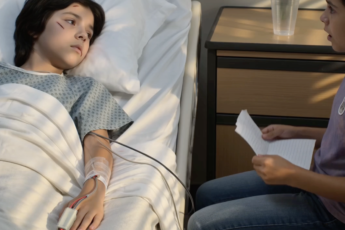
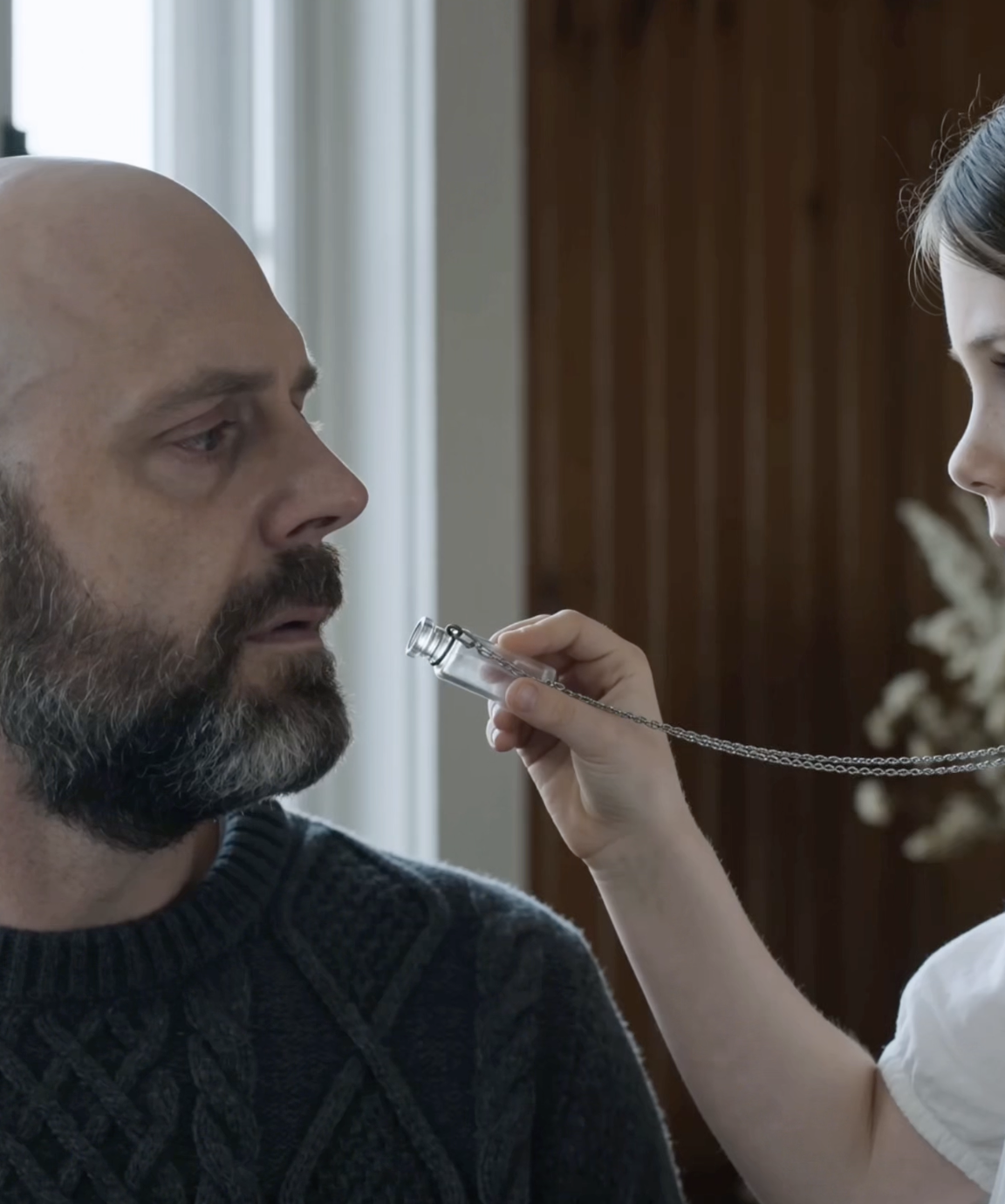
Lily Marsh began, on the morning of January 11, 2024 — three months and eight days after her mother’s death — to enter her father’s home office every morning at 7:15 AM with a small glass vial on a silver chain that she had retrieved from her mother’s jewelry box.
The vial had been, in her mother’s lifetime, a perfume bottle. It had held a small amount of a perfume Caroline had loved — a French perfume called Chamade, which Henry had given her on their tenth anniversary. The bottle was almost empty when Caroline died. Lily had emptied the last few drops onto a small handkerchief, which she had folded into the drawer of her bedside table, where it had stayed.
The empty vial was about the size of a strawberry. It had a small cork stopper. The silver chain had been added, some weeks later, by the woman at the small jewelry repair shop on Church Street whom Lily had paid two dollars and twenty-five cents in change to attach a chain so the bottle could be worn around her neck.
The woman at the jewelry shop, when she was finally interviewed by a journalist three years after the events of this story, said that she had assumed, at the time, that Lily was making the necklace as a memorial to her mother.
She said: “I asked her if she wanted me to engrave anything on the bottle. She said no, she didn’t want to put anything on it that couldn’t be taken off. I thought it was a strange way for a six-year-old to put it. But I was wrong about what she was using it for, and I’m glad I was.”
Lily entered her father’s office, on the morning of January 11, 2024, wearing the vial on the silver chain around her neck. Henry was sitting at his desk, looking at a book he had been not-reading for several months.
Lily stood beside his chair.
She took the vial off the chain.
She removed the cork.
She held the open vial up near her father’s face — close enough that, if he had been breathing in her direction, his breath would have entered the small open mouth of the glass.
She held it there for thirty seconds.
Then she replaced the cork. She put the vial back on the chain. She put the chain back around her neck. She said:
“I’m collecting your voice, Papa. A little bit every day. When the bottle is full, I’ll give it back to you.”
She kissed him on the cheek.
She left the room.
The next morning, at 7:15 AM, she came back.
She did the same thing.
She did the same thing every morning for the next three hundred and eight mornings.
What Henry Saw
Henry Marsh was a clinical psychologist.
He understood, from the first morning, what his daughter was doing.
He understood it in the language of his profession — ritualized externalization of grief affect, gentle exposure therapy by proxy, attachment-based regulatory scaffolding — and he understood it, more importantly, in the older and simpler language that had been the reason he had become a clinical psychologist in the first place, which was the language of a seven-year-old girl who had decided that if no one else was going to do something about her father’s silence, she was going to do something about it herself.
He did not, in the first weeks, react.
He was not capable of reacting.
His silence, by January of 2024, had moved beyond the volitional and into the deeply somatic. He had not, in the three months since his wife’s death, made a sound louder than a sigh. He had not, in the three months since his wife’s death, eaten a meal that he had not been physically led through by either Lily or his sister Margaret, who had moved into their guest bedroom that November. He had been bathing himself, dressing himself, and walking himself to the small park on the corner of their street twice a day, but he had been doing these things, his sister had told Dr. Ainsley, “like a man performing a role in a play where the script has been removed and only the stage directions remain.”
What Henry felt, on the morning of January 11, 2024, when his seven-year-old daughter held a small empty perfume vial near his face and told him that she was collecting his voice, was something he would later describe — in the only conversation he would ever have about the experience, a conversation he had at his daughter’s fourteenth birthday party, with Dr. Ainsley, on the porch of his sister’s lake house in Burlington — as “the first thing I felt as something rather than as an observation of something, in the entire one hundred and three days since I had stood up from my chair in my office and walked out the door without saying goodbye to the patient I had been failing for the previous eleven months.”
Dr. Ainsley had said, on the porch that night: “What did you feel?”
Henry had said: “I felt that my daughter had understood, somehow, what I had not been able to explain to anyone for one hundred and three days, which was that my voice was a separate thing from me, and that it had gone somewhere I could not reach, and that getting it back was not going to be a matter of me deciding to speak.”
Dr. Ainsley had said: “And you understood, in that moment, that she was right.”
Henry had said: “I understood, in that moment, that the only person in the world who had been telling me the actual truth about what was happening to me, since the afternoon Caroline died, was a six-year-old who had decided I needed help.”
What Changed
In the first month of Lily’s morning visits, Henry sat at his desk and watched her come in and watched her perform the small ritual and watched her leave.
In the second month, he began to make eye contact with her during the ritual.
In the third month, he placed his hand on her shoulder when she had finished — the first sustained physical contact he had initiated with her since her mother’s funeral.
In the fourth month, he began to cry, silently, after she had left the room.
In the fifth month, he began to cry while she was still in the room.
Lily, during the fifth month, when her father had begun to cry during the ritual, had paused on one morning — the morning of June 7, 2024 — and had put the vial down on the desk and had climbed, without speaking, into his lap, and had let him hold her, and had let him cry for what his sister Margaret would later say was forty-seven minutes by the kitchen clock.
When he had stopped crying, Lily had picked up the vial. She had completed the ritual. She had kissed him on the cheek. She had left the room. She had gone downstairs and had eaten the breakfast her aunt had made for her and had gone to school.
In the sixth month, Henry began, occasionally, to laugh.
He laughed silently. But he laughed.
In the seventh month, on August 23, 2024 — Lily’s seventh birthday — Henry made her a chocolate cake with white frosting and seven small candles on it, and he set it down in front of her on the kitchen table, and he stood beside her, and Margaret took a photograph that has, in the years since, become the only photograph of Henry Marsh from the year following his wife’s death that he has ever allowed anyone to publish.
In the photograph, Henry is not yet speaking.
But he is smiling.
And his hand is on his daughter’s shoulder.
And his daughter is laughing.
What Happened On The Morning Of November 14, 2024
It was a Thursday. It was cold. There had been the first heavy snow of the season the night before, and Henry, when he had woken up at 6:45 AM, had looked out the window of his bedroom and had seen the world covered in the kind of pristine white that, before his wife had died, had been one of the small things he had loved most about living in Vermont.
He had gotten dressed.
He had gone downstairs.
He had made coffee — his sister had taught him to make coffee again in February — and he had sat down at the kitchen table to wait for his daughter, who would come down at 7:00 AM, eat the small bowl of yogurt and honey her aunt always made for her, and then come up to his office at 7:15 AM with the vial.
Lily came downstairs at 7:00 AM.
She ate her yogurt.
She did not speak.
At 7:15 AM, she came into his office.
Henry was sitting at his desk.
She walked over to him. She stood beside his chair, the way she had stood beside his chair for three hundred and eight mornings.
She did not take the vial off the chain.
She said, very quietly, with the kind of solemnity a seven-year-old uses when she has decided that a thing she has been working on for ten months is now finished:
“Papa. The bottle is full. I am ready to give your voice back.”
She took the vial off the chain.
She removed the cork.
She raised the open vial gently to her father’s lips — close enough that the open mouth of the glass was almost touching his mouth.
She waited.
Henry Marsh sat at his desk and looked at his seven-year-old daughter, who was holding an empty perfume vial against his lips with a hand that was, despite her absolute seriousness, trembling.
He breathed in.
He breathed out.
He said:
“Lily.”
What Lily Did Next
Lily Marsh, when her father said her name out loud for the first time in three hundred and eight days, did not gasp.
She did not cry out.
She did not, in fact, do any of the things a younger child or a less self-possessed child might have done.
She simply closed her eyes.
She held them closed for several seconds.
When she opened them, she had begun to cry quietly. She replaced the cork in the vial. She put the vial back on the chain. She put the chain back around her neck. She looked up at her father.
She said:
“Hello, Papa.”
Henry said: “Hello, sweetheart.”
His voice was hoarse. It had been ten months and eleven days since he had used it. It sounded — Margaret, who heard it from the hallway, would say later — like the voice of a man who had been gone for a long time and had come home, finally, on a Thursday morning in November.
Lily said: “Are you back?”
Henry said: “I’m back, sweetheart.”
Lily said: “Are you going to stay back?”
Henry said: “I’m going to try, sweetheart.”
Lily nodded. She looked at the vial around her neck. She touched it with her fingers.
She said: “I’m going to keep this. In case you need it again.”
Henry said: “Okay.”
Lily said: “But I don’t think you will.”
Henry said: “I hope you’re right, sweetheart.”
Lily said: “I know I’m right.”
She kissed him on the cheek.
She left the room.
She went downstairs and told her aunt that her father had said her name out loud, and her aunt — who had been the one human being in Henry Marsh’s life who had not been afraid, in all ten months, to ask him every single morning how he was feeling — sat down on the kitchen floor and cried for the first time since her sister-in-law had died.
What Happened After
Henry Marsh did not, after the morning of November 14, 2024, immediately resume the life he had been living before his wife’s death.
His voice came back slowly.
The first day, he said three sentences total.
The second day, he said seven.
By the end of the first week, he was speaking enough to ask his sister, over dinner, about her own life — a question he had not asked her in fourteen months, and a question she had been waiting for him to ask for the last twelve.
In the second week, he began to call his colleagues. He apologized, individually, to each of the patients he had abandoned without explanation on the afternoon of October 3, 2023. The young man whose appointment had been interrupted — the one who had spent the year working on whether his father had ever been proud of him — wrote Henry a letter back that said, in part: “I want you to know that the afternoon you stood up and walked out without saying anything was, looking back, the most useful thing that ever happened in my therapy. You showed me, by accident, that grief is a real thing that even the people I had assumed were beyond grief could be brought to. That made my own father suddenly possible to me in a way he had not been before. Thank you. Please do not feel that you owe me anything.”
Henry returned to his practice in February of 2025.
He did not return as the clinician he had been before his wife died.
He returned as something else.
His colleagues, when they were asked — and they were asked, because the story of Henry Marsh and the small glass vial had begun, by the spring of 2025, to circulate through the small mental health community of northern New England in the way these stories do — said only this:
“He listens differently now. He always listened well. But now he listens like a man who has been listened to by his own daughter for ten months, and like a man who knows what it cost her.”
What Lily Has
Lily Marsh is now ten years old.
She still wears the vial on the silver chain around her neck.
She has, in the three years since her father said her name out loud on the morning of November 14, 2024, never once removed it.
She does not, anymore, perform the ritual.
She has not, since the morning of November 14, 2024, opened the vial.
She has, however, on three separate occasions in the last three years — once after her father caught a bad case of influenza and was unable to speak for two days, once after he received news that one of his oldest friends had died, and once on the anniversary of her mother’s death — quietly touched the vial against her father’s cheek, before bed, without speaking.
Each time, her father has placed his own hand briefly over her hand, and the vial.
Each time, he has whispered: “Thank you, sweetheart.”
Each time, Lily has whispered back: “I told you I would keep it. Just in case.”
She still has it.
She still keeps it.
She intends, she has told her aunt, to keep it for the rest of her life.
And then, she has told her aunt — because Lily Marsh is, at ten years old, still the kind of child who thinks about things much larger than ten-year-olds are usually thought to think about — she intends to pass it down.
Her aunt asked her, gently, who she intended to pass it down to.
Lily said: “Whoever, in the family, needs it next.”
Her aunt said: “How will you know who needs it?”
Lily said: “I’ll know.”
Her aunt did not, after this answer, ask any further questions.
She believed her.
She still does.
“I’m collecting your voice, Papa.
A little bit every day.
When the bottle is full, I’ll give it back to you.”
If this story moved you, share it with someone who needs to hear it.
Some children are sent to us because we cannot save ourselves.
Some grief is not a thing to be solved but a thing to be held, every morning, by a small hand that has decided to hold it until we are ready to hold it ourselves.
And some glass vials are full of nothing at all, except every breath someone we love took, every morning, for the ten months it took to bring us home.