Part 2: The Truth She Hid Under the Floorboard
She had not climbed those attic stairs in twenty-seven years.
Not once. Not for Christmas decorations. Not when the roof leaked in ’04. Not when her husband died and she could have asked her son-in-law to bring down the old albums. She paid a man two hundred dollars to do it instead.
Because the only thing in that attic that mattered to her was a small wooden box, hidden under the third floorboard from the window. And she had promised herself — the day she put it there — that she would never look at it again.
Her brother’s funeral had ended an hour ago.
The last guest had left a polite kiss on her cheek and a casserole in the kitchen. Her daughter had offered to stay the night. She had said no. She wanted to be alone in the house, she said. To grieve.
That was not entirely a lie.
She wanted to be alone in the house to finally burn what was in that box.
The Climb
The attic stairs creaked the way she remembered. The dust on the railing was so thick her hand left a clean print, like a confession.
At the top, the air was warm and still. Late afternoon sun came in through the small round window — the same window that had been her witness in 1998.
She knelt where she had knelt then. Her knees were not the same knees.
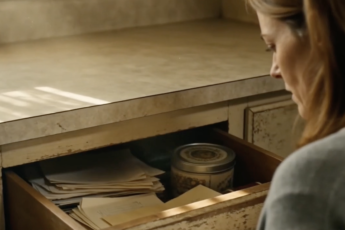
She put her palm flat on the floor and felt for the loose board. There it was, exactly as she had left it — the one nail head she had deliberately not hammered all the way down, so she would always know which one to lift.
The board came up with a soft pop.
The box was waiting.
She lifted it out and set it on her lap. The lid was furred with grey dust. She dragged her finger across it, leaving a single clean stroke — and that small clean line undid something in her she had spent twenty-seven years tying shut.
What Was Inside
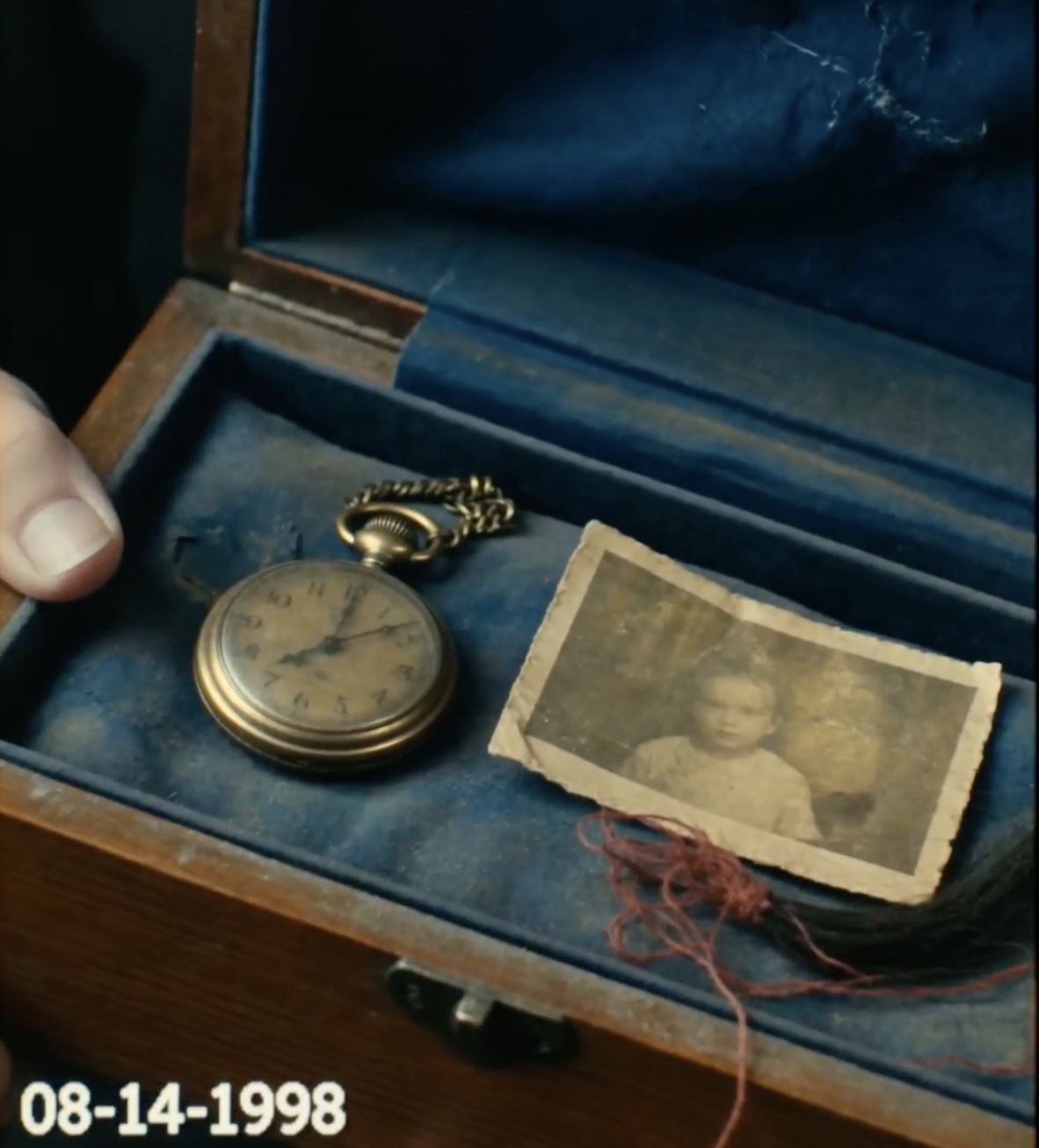
Three things, exactly as she had left them.
A child’s gold pocket watch, tarnished now, the chain coiled like a sleeping snake.
A folded photograph, the paper gone the color of weak tea.
A lock of dark baby hair, no larger than a thumbnail, tied with a piece of red thread she had retied a hundred times during the year she still allowed herself to look at it.
She did not pick up the watch.
She picked up the photograph first, because the photograph was easier. It was a Polaroid. A young woman she did not want to name, sitting on a hospital bed, holding a newborn wrapped in a yellow blanket. The young woman was smiling the way people smile when they have just been told they are about to lose everything.
She placed the photograph face-down on the floor.
Then her thumb brushed the watch.
And that was the moment a floorboard creaked behind her.
The Boy
He was small. Eight, maybe nine.
His feet were bare and the soles were almost black with road dirt. His corduroy pants were two sizes too big and held up with a piece of twine. He had a small scab on his chin and a cowlick in his dark hair that no one had bothered to flatten for him this morning.
He was holding the doorframe with one hand. He was not crying. He was not breathing fast. He was not afraid of her.
He had her brother’s eyes.
She did not have time to be confused. She did not have time to ask how he had gotten in, who had brought him, why he was here on the day of a funeral he could not possibly have been invited to.
Because the boy spoke first.
He said, in a voice that broke on the second word:
“Grandma. He said you’d know my name.”
The watch slipped through her fingers and landed on the velvet inside the box, soundless.
She knew his name.
Of course she knew his name. She had been the one to write it down on a piece of paper twenty-seven years ago. She had been the one to hand that piece of paper, along with an envelope full of cash, to a woman she had never seen before and would never see again.
She knew his name the way some people know the date of their own death.
The Name
She lowered her hand from her mouth. She had been pressing it there so hard her fingers had left marks on her cheek.
She looked at the boy. He looked back at her with a patience no eight-year-old should own.
And she said the name out loud for the first time in twenty-seven years.
She said her sister’s name.
Not the sister who had cried at the funeral that morning. Not the sister who had inherited the house, the watches, the gold.
The other sister. The one no one in the family was allowed to mention. The one who had been sent away in the summer of 1997 because she had fallen in love with the wrong man and refused to be ashamed of it.
The one who had given birth, alone, in a state hospital eight hundred miles from home, and was told by her own family that the baby had died.
The baby had not died.
The baby had been given away — for a price — to a woman who had wanted a child for ten years and could not have one. And the only person in the entire family who had known the truth, the only person who had arranged the paperwork and signed the check and chosen the new mother and promised herself she was doing the right thing for everyone, was the elegant woman now sitting on a dusty attic floor with a gold watch in her lap.
The boy in the doorway was not her brother’s son.
The boy in the doorway was her sister’s grandson.
The sister she had told everyone was dead.
The sister who, it turned out, had spent twenty-seven years searching for the child she had been told was buried — and had finally, somehow, found him. Had told him everything. Had given him the only address she still remembered.
And had sent him here, on the day of the family funeral, to ask one question out loud, in front of God and the dust and the gold watches:
Was it you?
What She Did Next
She did not answer him with words.
She picked up the gold pocket watch from the velvet. She turned it over in her palm. She rubbed her thumb across the engraving on the back — the engraving she had not allowed herself to read since 1998 — and she read it now, in the warm window light, with a child she did not know watching her face.
It was not a name.
It was a date. The date her sister had given birth. Engraved by their own mother, who had known the truth all along, and had spent the last six months of her life trying to tell someone — anyone — and had died with the secret still locked behind her teeth.
The elegant woman closed her eyes for a long moment.
And then she did the thing she had not done in twenty-seven years of polite black dresses and careful smiles and inherited china.
She told the truth.
She told it to an eight-year-old boy with dirty feet, sitting cross-legged on her attic floor, eating a peanut butter sandwich she had made him in the kitchen while her hands shook so hard she dropped the butter knife twice.
She told it to her daughter on the phone an hour later. Her daughter did not speak for a full minute. Then her daughter said “Mom” in a voice she had never heard her daughter use before.
She told it to her remaining sister the next morning, in the same kitchen where they had grown up. Her sister broke a coffee cup against the wall and screamed and then cried, and then, after two hours, asked the only question that mattered:
“Where is she now?”
The boy had the address in his pocket. He had walked it from memory three times before he came here, just to make sure he would not lose it.
Three families fell apart that week.
A fourth one — the one that had been broken for twenty-seven years — finally began to come back together.
What She Said When I Asked Her Why
I sat with her last winter. She is eighty-one now. The boy is grown.
His grandmother — the sister everyone said was dead — lived to see him graduate. She died holding her daughter’s hand, in a bed that her older sister, the elegant one, paid for.
I asked the elegant woman the only question I had been waiting to ask.
I asked her why she had hidden the box instead of destroying it.
She thought about it for a long time. Then she said this:
“Because some part of me always knew that one day a child would come up those stairs. And I wanted there to be proof. I wanted there to be a way for the truth to find me — even after I had spent my whole life running from it.”
She paused. Then she said the line I have not been able to forget.
“You don’t hide the things you want to forget.
You hide the things you are not yet brave enough to remember.”
If this story moved you, share it with someone who needs to hear it.
Sometimes the people in our families are not the ones we think they are.
And sometimes the truth waits twenty-seven years in the dust — for a barefoot child to bring it home.