Part 2: How Sarah Vance Brought Down the Whitmore Family in Six Minutes
Sarah Vance had been carrying her mother’s pointe shoes in a duffel bag for three years.
Not in her closet. In a duffel bag, in the trunk of her 2004 Honda Civic, in a parking garage on Calhoun Street in downtown Charleston. The duffel bag had a padlock she had bought at a Walmart in 2022. The padlock combination was the day her mother died.
Her mother had been twenty-six years old when those pointe shoes were new. Sarah was eleven when she had last seen her mother wear them. Sarah was twenty-four years old now, and she had not put the shoes on her own feet — not once — until the night of November 4, 2026, in the staff bathroom of the Dock Street Theatre, with the door locked, exactly thirty-eight minutes before the Whitmore Family Foundation Gala began.
She put them on slowly. She took her time. She tied the frayed ribbon with the messy knot her mother had tied the night before her arrest, because that knot was the last thing her mother had ever done to those shoes, and Sarah had not been willing to untie it.
She looked at herself in the bathroom mirror.
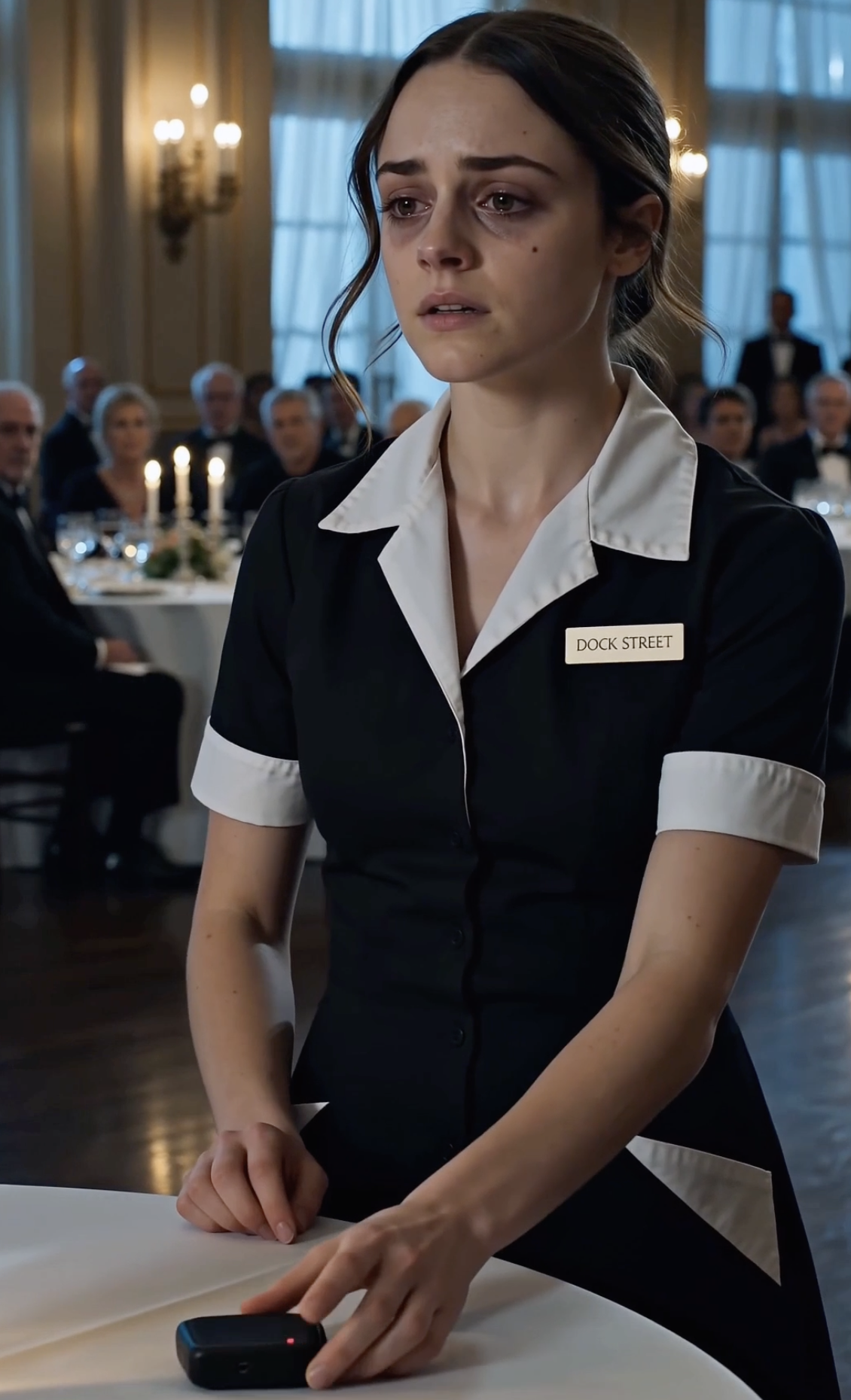
She was wearing a black Dock Street Theatre waitress uniform — white collar, white apron tied at the waist, brass name tag on her left chest. Pink pointe shoes on her feet that had not been on a stage in thirteen years. Hazel eyes red-rimmed because she had been crying in the parking garage at six o’clock that evening, alone, sitting on the hood of her Civic, before she had let herself come inside.
She did not look like a dancer.
She looked like a waitress wearing dead woman’s shoes.
That was exactly what she was.
What Happened in 2013
Eleanor Vance was twenty-six years old in the autumn of 2013. She was the principal dancer of a small Charleston-based ballet company called Tideline Dance Theater. She had no formal training — she had taught herself from videos, from books, from one semester of community classes she could not afford to finish. She danced like someone who had not been told yet that she was not supposed to be able to.
She was the single mother of an eleven-year-old daughter. She lived in a one-bedroom apartment above a hair salon on King Street. She made eighteen thousand dollars a year before tips from her weekend job at a coffee shop on East Bay.
In October of 2013, the Whitmore Family Foundation chose Tideline as the centerpiece of their inaugural gala. Eleanor was given the closing solo. The foundation paid Tideline twelve thousand dollars for the evening’s performance. Eleanor, as the soloist, was given five hundred dollars and a borrowed dress.
The gala was held in the Dock Street Theatre. Three hundred guests. Black tie. Old Charleston money. Eleanor’s daughter, Sarah, who had just turned eleven the week before, was in the audience for the first time in her life, wearing a yellow dress her mother had sewn for her.
Eleanor danced the closing solo. She received a standing ovation that lasted four minutes.
After the performance, while Sarah was eating a cookie at the children’s table at the back of the ballroom, Vivian Whitmore — wife of the foundation’s late benefactor, mother of the foundation’s twenty-one-year-old president-in-waiting Alexander Whitmore — invited Eleanor to a private room behind the stage. She told Eleanor she had a gift for her. A gift, she said, that recognized “an extraordinary talent we want very much to keep.”
The gift was a diamond bracelet. Thirty-six brilliant-cut stones set in eighteen-karat yellow gold. It had belonged to Vivian Whitmore’s mother. It was worth, according to the insurance documents, eighty-four thousand dollars.
Vivian told Eleanor she could keep it.
She told her: “This is what gratitude looks like in this family. We hope you’ll learn what it can mean to be on the right side of that gratitude.”
Then she told Eleanor that her son, Alexander, would like to take her to dinner the following Friday.
Eleanor did not say yes. She did not say no. She took the bracelet.
Three weeks later, on the morning of November 22, 2013, two Charleston Police Department detectives arrived at Eleanor Vance’s apartment with a warrant. They found the diamond bracelet wrapped in a silk scarf in the bottom drawer of her dresser. Vivian Whitmore had reported it missing from her personal jewelry case the previous night.
Eleanor was arrested. She did not resist. She did not call a lawyer. She did not even ask to make a phone call until they had been booking her for twenty minutes, and then the only call she made was to her landlord — to ask if her eleven-year-old daughter could stay in the apartment until Eleanor’s sister could drive down from North Carolina to get her.
Sarah Vance went into the foster care system in Greenville, South Carolina, two weeks later.
Eleanor pleaded guilty to grand larceny on the advice of the state-appointed attorney who told her, accurately, that she could not afford to fight the Whitmore family and that a guilty plea would get her three years instead of fifteen.
She served two years and eleven months. She died of untreated pneumonia in the women’s correctional facility in Columbia, South Carolina, on February 21, 2016. Her daughter was thirteen years old. Her sister, Sarah’s aunt, could not afford to bring her body home for a funeral. Eleanor was buried in the prison cemetery, in row 14, plot 27.
That was the end of the story, as far as the Whitmore family was concerned.
The bracelet was returned to Vivian Whitmore. She wore it again at the foundation’s gala in 2014, and the gala in 2015, and the gala in 2016 — three weeks after Eleanor’s funeral, photographed on her wrist as she shook hands with the mayor.
What Eleanor Did Before She Died
What Vivian Whitmore did not know — what no one knew, except for two people, neither of whom were in any hurry to talk — was this:
Eleanor Vance had not stolen anything.
The bracelet Vivian Whitmore had given her on October 19, 2013, was Eleanor’s. Legally. Documented. Gifted.
Eleanor had not been stupid. She had grown up the daughter of a paralegal in Asheville. She had known, from the moment Vivian Whitmore placed the bracelet in her hand and mentioned Alexander Whitmore in the same conversation, exactly what kind of arrangement was being proposed.
She had taken the bracelet. She had thanked Vivian Whitmore. She had walked out of the back room of the Dock Street Theatre.
She had gone directly to a 24-hour notary on Meeting Street and had Vivian Whitmore’s gift documented in writing, with the bracelet photographed against a hotel notepad bearing that night’s date and the time-stamp of 11:47 PM. The notary, an elderly woman named Doris Whitehead, witnessed and signed and dated the document. Eleanor paid her thirty-five dollars in cash. She had brought the money with her from her tip jar.
Then she had gone to a 24-hour Wells Fargo branch and placed the bracelet, the document, the notary’s contact information, and a sealed handwritten letter into a safe deposit box. Box number 1247. She had paid for thirty years of rental upfront, in cash — $640. She had walked out of the bank at 1:23 AM with the receipt and the key.
The next morning she had mailed the key, the box number, the bank address, and a single sheet of instructions to her sister in North Carolina with a note: “Open only if I am arrested. The combination on the box is Sarah’s birthday.”
She had not told anyone else. Not her lawyer. Not her sister, beyond what was in the envelope. Not her daughter.
Three weeks later, when the police arrested her, Eleanor was prepared.
The reason she had pleaded guilty was not that she was guilty. The reason was that she was twenty-six years old, with an eleven-year-old daughter, and a state-appointed attorney told her in plain language: “The Whitmores will outspend you. The bracelet doesn’t matter — they will produce three witnesses who say you took it. They will produce an insurance claim. They will produce their son who will testify that you propositioned him. You will lose. The only question is whether you lose for three years or for fifteen.”
She had taken three years.
She had assumed she would survive prison.
She had assumed she would come home, retrieve the safe deposit box, and use the documented evidence of Vivian Whitmore’s gift to publicly destroy the family that had taken her dignity and her daughter.
She had not assumed she would die in prison.
Six weeks before she died, she had asked the prison chaplain to bring a portable cassette recorder into her cell. The chaplain — a woman named Sister Mary Helen, who had been visiting Eleanor every Tuesday for two years — had quietly done so. Eleanor had recorded a single five-minute tape. She had given it to Sister Mary Helen with one instruction: “When my daughter Sarah turns twenty-one, please find her, give her this tape, and tell her about the safe deposit box.”
Sister Mary Helen had kept that promise.
She had found Sarah Vance in November of 2023, on Sarah’s twenty-first birthday, in the small apartment above a laundromat in Greenville where Sarah was living and working two jobs. She had handed Sarah a manila envelope containing the cassette tape, a written transcript, and the address of a Wells Fargo branch in Charleston.
Sarah had listened to the tape that night. She had cried for six hours straight. The next morning, she had quit her two jobs in Greenville, packed her car, and moved to Charleston.
It had taken her eleven months to get the job at Dock Street Theatre. She had applied in person. She had told them she was a part-time dance instructor at a small studio in West Ashley and wanted weekend hours. None of that was true. She had not danced since she was eleven years old.
She got the job in October of 2024.
She started planning the gala from her first week.
What She Did at the Gala
The Whitmore Family Foundation Tenth Anniversary Gala was held at the Dock Street Theatre on November 4, 2026 — thirteen years to the day after the first gala at which her mother had been given the bracelet.
Sarah had requested the night off. Her manager had refused. She had said it was an all-hands-on-deck event, and she would need every server in the building.
That was, of course, exactly what Sarah had wanted.
She arrived at four in the afternoon. She set tables. She polished crystal. She filled ice buckets. She did not speak to anyone unless spoken to. The Whitmore family arrived at six. Alexander Whitmore, now thirty-four years old, walked past her three times during the cocktail hour. He did not look at her. She did not look at him.
At seven-fifteen, during the main course, she went to the staff bathroom and put on her mother’s shoes.
At seven-fifty-two, during a transition between the keynote speaker and the first dance performance of the evening, she walked out of the kitchen, removed her apron in the doorway of the ballroom, and stepped onto the empty dance floor.
She did not warn the band. She did not warn the event coordinator. She did not warn anyone.
The string quartet stopped playing because they did not know what else to do. The conversation in the room faltered. Three hundred guests turned, slowly, to look at the woman in the waitress uniform standing in the middle of the floor in worn pink pointe shoes.
She had paid the theater’s sound technician — a twenty-six-year-old man named Marcus Reynolds who worked nights at Dock Street and weekends at the Charleston Music Hall — three thousand dollars in cash one week earlier to do a single thing. When she gave a hand signal from the floor, he was to lower the lights to seventy percent and pipe a piano track she had given him through the main ballroom speakers.
She gave the hand signal.
The lights dropped. The piano began. Sarah danced.
She danced the closing solo from her mother’s 2013 performance. She had not been taught it. She had reconstructed it from a single grainy YouTube video uploaded by someone who had attended that gala, which had been on YouTube the entire time, with seventeen views, the last one her own from the previous Saturday night. She had practiced the solo every night for fourteen months in the empty studio of a Charleston Ballet School at three in the morning, the only time she could afford the rental.
She was not a good dancer. Her mother had been a great dancer. Sarah was a working-class woman in pointe shoes that hurt her feet, performing from memory and grief, on a polished wood floor in front of three hundred people who had taken her mother away from her.
It was the most beautiful three minutes any of those three hundred people had seen in a very long time. Six of them have told me, in the months since, that they will not forget it for the rest of their lives.
When she finished, she walked across the floor — slowly, deliberately, the worn pink ribbons trailing — and she stopped directly in front of the Whitmore family’s table.
Alexander Whitmore was sitting frozen with a champagne flute halfway to his lips.
His mother, Vivian Whitmore, was sitting beside him in an emerald evening gown, the diamond bracelet on her left wrist.
Sarah did not say a word.
She reached into her uniform pocket. She removed a small Bluetooth speaker. She set it on the white tablecloth between Alexander’s plate and Vivian’s. She pressed one button.
The speaker, which she had paired earlier that day with the theatre’s main sound system, connected immediately. Her mother’s recorded voice began to play through every speaker in the ballroom.
What the Recording Said
The voice was a woman’s. It was slightly tape-compressed, slightly rough, slightly muffled by the chaplain’s old cassette recorder. It was unmistakably Eleanor Vance.
She said:
“Sarah. If you are hearing this, the bracelet is somewhere they cannot reach. I want you to know first, before you do anything else, that I did not steal it. Vivian Whitmore gave it to me. She gave it to me in front of her own assistant in the back room of the Dock Street Theatre on the night of October 19, 2013. The assistant’s name was Karen Beaufort. She was twenty-three years old. She has since left the family’s employment. I want you to find her. She remembers.”
“Vivian gave me the bracelet because she wanted me to sleep with her son. I did not sleep with her son. He came to my apartment three nights after the gala. He was drunk. I asked him to leave. He left, but he was angry, and he told his mother. Vivian decided that if I would not be useful, I would be made a lesson. I knew, from the moment she gave me the bracelet, what kind of woman she was. I do not blame myself for taking it. I blame myself for thinking I could outrun her.”
“The bracelet is in a safe deposit box at the Wells Fargo on East Bay Street. The box number is 1247. The combination is your birthday. There is also a notarized document from a woman named Doris Whitehead. She is still alive — I have asked Sister Mary Helen to verify this each year. She will testify to what she saw. Her phone number is on the back of this transcript.”
“Sarah. I am sorry I am not coming home. I want you to do whatever you need to do with this information. If you want to publish it, publish it. If you want to take it to the police, take it. If you want to forget it ever existed, do that too. It is yours now. I have been holding it for you for as long as I could.”
“I love you, my girl. I have always loved you. I have always been on your side. I am still on your side. I will always be on your side, even from wherever I am now.”
“Mom.”
The recording was six minutes and forty-one seconds long.
Nobody in the ballroom moved during any of it.
Vivian Whitmore was very still. She did not look at the bracelet on her own wrist. She did not look at her son. She looked at the small Bluetooth speaker on the tablecloth in front of her, as if it were a snake.
Alexander Whitmore tried, twice, to stand up. Twice, the man at the table next to him — an older Charleston attorney who had known the Whitmore family for thirty years — placed a hand on Alexander’s shoulder and held him in his chair.
When the recording ended, the ballroom was completely silent for eleven seconds.
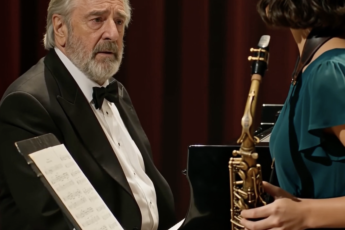
Then an elderly man at a distant table — a retired professor from the College of Charleston named Henry Whitfield, who had been the keynote speaker at the 2013 gala and who had personally watched Eleanor Vance dance her closing solo thirteen years earlier — stood up. He did not say anything. He simply stood, and he turned, and he faced Sarah Vance.
Then a woman at the next table stood. Then her husband. Then the entire table behind them.
By the end of the next two minutes, every one of the three hundred guests in the ballroom was standing — every one of them facing Sarah Vance, every one of them with their back turned to the Whitmore family’s table.
Nobody clapped. Nobody spoke. They simply stood, and watched, in total silence, for four minutes and ten seconds.
When the silence ended, the journalist Sarah had been working with for the last sixteen months — a thirty-eight-year-old investigative reporter for the Charleston Post and Courier named Maya Edelstein, who had been seated at table 18 with a press credential and a recording device — published the full story on the Post and Courier website at 8:47 AM the following morning.
What Happened After
Vivian Whitmore was charged with perjury, conspiracy to commit grand larceny, and obstruction of justice on December 4, 2026 — thirty days after the gala. She was sixty-four years old.
Alexander Whitmore was charged with subornation of perjury and conspiracy to commit larceny three days later. He was thirty-four years old.
Both pleaded not guilty. Both are awaiting trial as of this writing.
The Whitmore Family Foundation suspended operations on December 15, 2026. A federal investigation into the foundation’s financial activities — initiated by the IRS based on a tip from Maya Edelstein’s second article, published two weeks after the first — uncovered substantial evidence of money laundering through several South Carolina shell corporations. The foundation was formally dissolved by a federal court in August of 2027. Its remaining assets, after legal fees, totaled $11.2 million. By court order, these funds were placed into a state-administered trust for the support of Charleston-area performing artists from low-income backgrounds.
The trust is called the Eleanor Vance Memorial Fund.
Sarah Vance is now twenty-five years old. She is a first-year law student at the University of South Carolina on a full scholarship from the Eleanor Vance Memorial Fund. She is one of fourteen students supported by the trust in its first year of operation.
She is, in her own words, “in no particular hurry” to graduate.
Her mother’s pointe shoes are now on permanent display, along with the diamond bracelet, at the Gibbes Museum of Art in Charleston. The exhibit was donated by Sarah Vance in March of 2027. The display card reads:
“On loan from the Vance family. The bracelet that paid for the truth. The shoes that took it back. — Eleanor Vance, 1987-2016.”
The chaplain, Sister Mary Helen Garrigan, retired from prison ministry in May of 2027. She lives in a small house in Summerville, South Carolina, with three cats. She attends Sarah’s law school graduation each spring as Sarah’s guest.
The notary, Doris Whitehead, is ninety-one years old. She testified before the grand jury in February of 2027. She has been retired for twelve years. She told me, when I asked her last summer why she had kept the document and the contact information for thirteen years without throwing them away, that she had not. “I threw them away the day after Mrs. Vance was arrested. I had a feeling in my stomach. So I drove to the dump in the morning and I got them back. I have moved them between three houses since. It cost me nothing. I do not know how to explain what told me to keep them. I am old enough now to know that some things tell you, and you listen.”
The elderly professor, Henry Whitfield, died of pancreatic cancer in July of 2027 at the age of eighty-one. His widow has told the Charleston papers that the last conversation she had with him, in the hospital, was about the night of the gala. He told her: “I had been ashamed for thirteen years that I did not say anything in 2013. I did not know what to say, and I did not know what to do, and I let it go. Standing up at that table, in front of my entire community, with my back to the people who had run the foundation that paid for half of my retirement — that was the only thing I have done in my eighty-one years that I am completely proud of.”
The Whitmore house on Tradd Street was sold in October of 2027 to pay legal fees. The bracelet remains in the Gibbes Museum.
What I Asked Her
I sat with Sarah Vance last October, just outside Charleston, on the porch of the small rental house she shares with two other law students.
She is twenty-five years old. She is taller than I expected. She wears her hair in the same low bun she wore that night — out of habit, she says, not as a symbol.
I asked her the only question I had been wanting to ask.
I asked her, if her mother had not died — if Eleanor had come home from prison in 2016 and done all of this herself — what she thought her mother would have done differently.
She thought about it for a long time. She was holding a glass of iced tea. She did not drink from it.
Then she said:
“Nothing. My mother would have done exactly what I did. Not because we are similar — although we are — but because the only way you can take a story this long and this carefully constructed and make it into a single moment is to do it the way she would have done it. The choreography was hers. I just performed it eleven years late.”
She paused.
“The only difference is that she would have danced it better than I did. I am not a dancer. I never was. But that’s part of the point, I think. She was the one with the gift. They took the gift. So when I came back to that ballroom, I did not come back as a dancer. I came back as her daughter. And that is what they had to face.”
She paused again.
“I think the worst thing you can do to someone like Vivian Whitmore is not to be talented. It’s not to be rich. It’s not to be powerful. It’s to be unkillable. My mother was not unkillable — they did kill her. But my mother and I, together, in the way she planned this — we were.”
“Some choreography takes a generation to finish.
And some debts can only be paid in front of three hundred witnesses.”
If this story moved you, share it with someone who needs to hear it.
Somewhere, the work that was started before you was meant for you to finish.
Don’t be in too much of a hurry.